
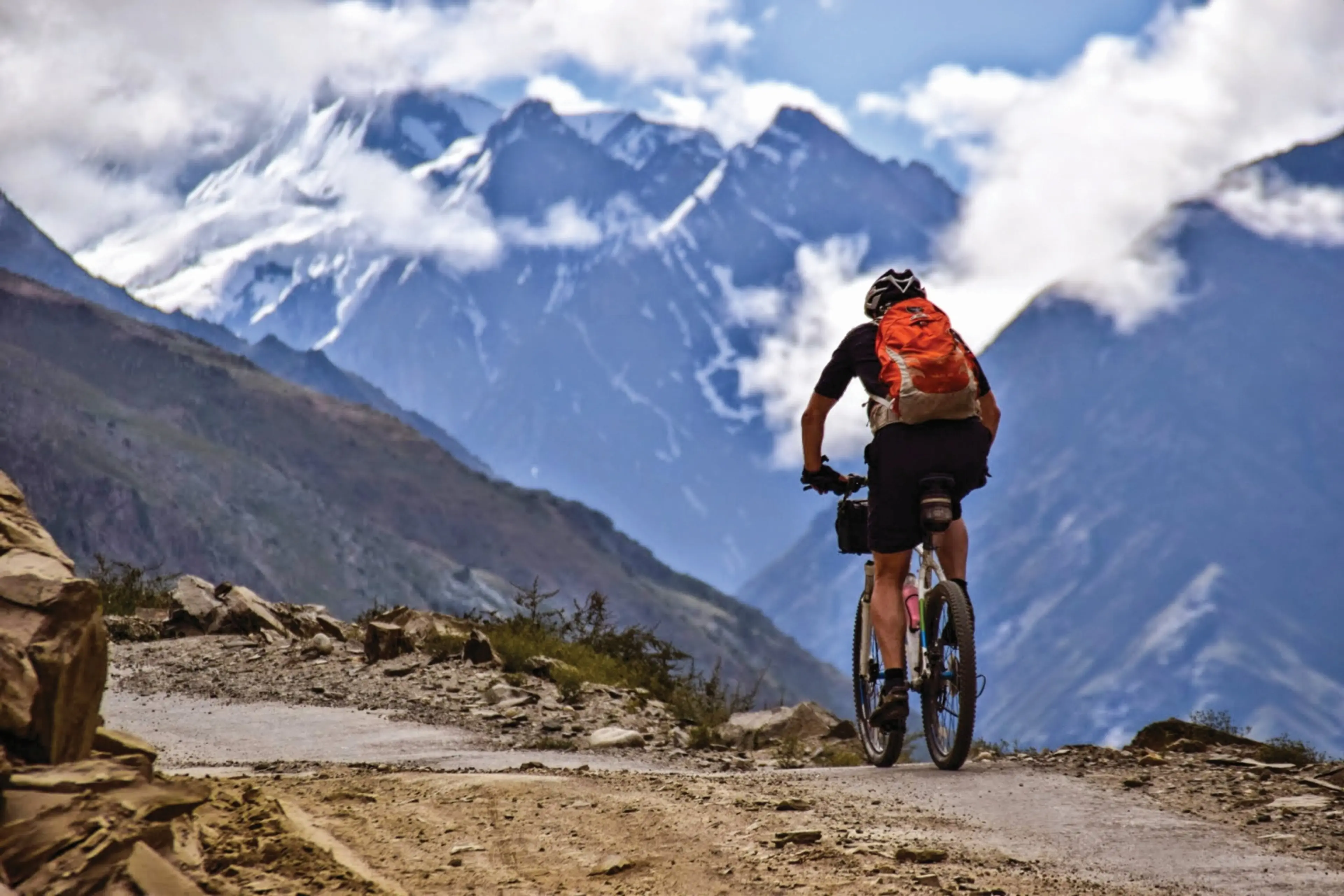
Eastern Extreme — Mountain Biking India Through the Silk Route and High Himalayas
There are routes in the Himalayas that test endurance, and then there are routes that fundamentally alter how you understand movement across terrain. The old Silk Route of East Sikkim belongs to the latter. It is not simply another entry in the expanding landscape of mountain biking India, but a route defined by constant transition — where altitude, surface, and environment shift continuously, demanding adaptation at every stage.
For riders seeking a deeper engagement with Himalaya biking India, the Eastern Himalayas offer something distinct from more familiar high-altitude regions like Ladakh or Spiti. Here, the journey is not defined by vast emptiness alone, but by variation — dense forests giving way to exposed ridgelines, humid valleys transitioning into cold, wind-swept plateaus. This layered progression makes it one of the most compelling India biking tours for those looking beyond predictable cycling landscapes.
Those who plan biking tours in India Himalayas often approach this route expecting challenge. What they encounter instead is a sequence — a journey where each segment prepares you for the next, building both physical endurance and spatial awareness over time.
Entering the Eastern Himalayas — The Silk Route Corridor
The entry into the Eastern Himalayas is gradual, almost deceptively so. The early stages do not immediately reveal the intensity of the route. Instead, the climb unfolds in layers — vegetation thickens, roads narrow, and humidity gives way to cooler air. This transition defines the beginning of biking North East India, where the experience is shaped as much by change as by distance.
Unlike more direct high-altitude routes, the Silk Route introduces riders to elevation progressively. This allows both the body and the landscape to adjust, creating a rhythm that becomes central to mountain biking Sikkim.
The Historical Spine of the Route
The Silk Route is not merely a physical trail; it is a historical corridor that once connected India to Tibet through trade and cultural exchange. Riding along this path today is less about retracing those journeys and more about experiencing their residual structure. Villages appear at intervals that reflect older movement patterns, while road alignments prioritise access over efficiency.
Those who explore eastern Himalayas bike tour routes often find that this historical layering adds depth to the ride. It transforms mountain biking India from a purely physical activity into an encounter with geography shaped by human movement over centuries. The route carries memory — not visibly, but spatially.
Terrain That Evolves Constantly
One of the defining characteristics of this route is its refusal to stabilise. Surfaces change without warning — from damp forest trails to broken tarmac, from steep gradients to narrow ridgelines. Riders who prepare for mountain road biking India often underestimate how quickly these transitions occur.
This variability is not incidental; it is fundamental to Himalaya biking India in the east. It requires continuous recalibration — of pace, balance, and energy output. Over time, riders begin to adapt not just physically, but mentally, learning to anticipate change rather than resist it.
Climbing Into Altitude — Zuluk to Nathang Valley
The ascent toward Zuluk marks a structural shift in the journey. What begins as a gradual climb transforms into a defined progression of elevation, where the road itself becomes a visual representation of effort. The famous Zuluk loops introduce riders to the geometry of ascent, stacking hairpin bends in a sequence that is both precise and relentless.
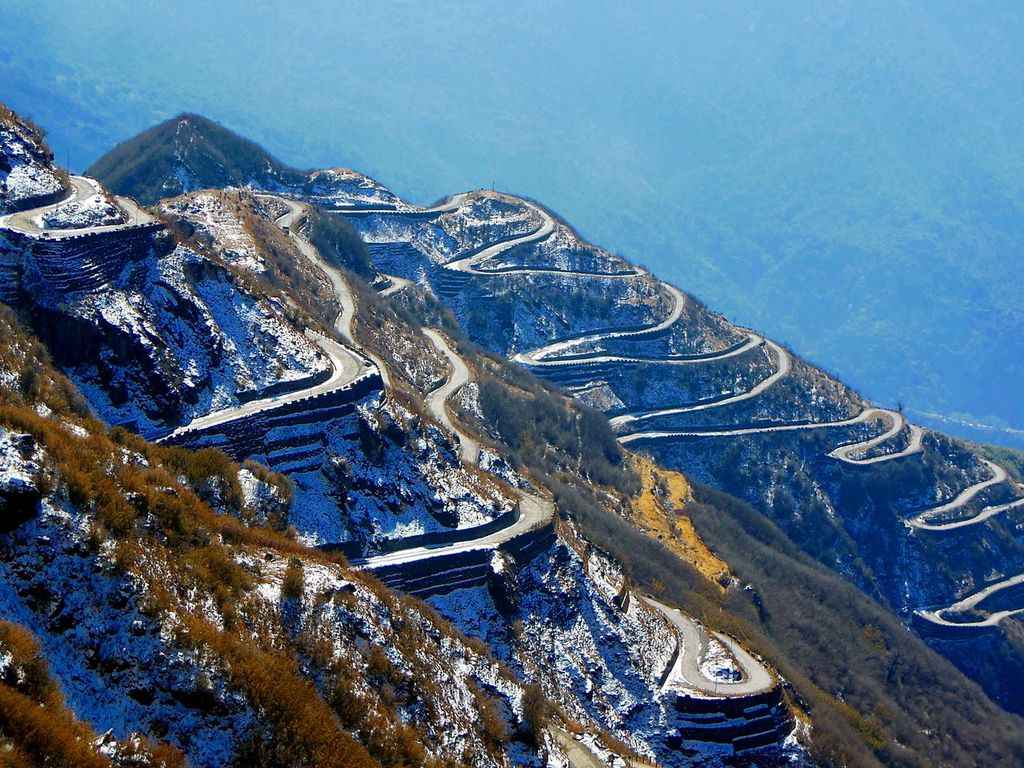
This is where high altitude biking India begins to assert itself. The climb is no longer just physical — it becomes psychological, requiring sustained focus and pacing.
The Geometry of Climbing
The Zuluk loops are often cited in discussions of riding in Himalayas India because of their visual and physical intensity. Each turn reveals the previous one, creating a layered perspective that allows riders to see both progress and distance simultaneously.
This visual feedback creates a unique dynamic. Progress is measurable, but so is the remaining effort. Within mountain biking India, few sections offer such a clear intersection of geometry and endurance. The climb becomes structured, almost architectural, reinforcing the sense of movement through space.
High-Altitude Adaptation
As the route climbs beyond Zuluk toward Nathang Valley, environmental conditions begin to shift noticeably. Vegetation recedes, temperatures drop, and oxygen levels decrease. Riders who understand high altitude biking India recognise that this is where strategy becomes critical.
Effort must be moderated, hydration managed carefully, and pacing adjusted to account for reduced oxygen availability. Nathang Valley, at over 4,000 meters, introduces riders to a plateau environment where exposure replaces enclosure. This transition marks a key stage in India biking tours, where adaptation determines sustainability.
Riding the Edge — Toward the Tibetan Plateau
Beyond Nathang, the landscape changes again — this time toward openness. Forests disappear, and the terrain expands into wide, exposed stretches that feel closer to the Tibetan plateau than to typical Himalayan environments. This is where scale becomes the defining element of biking North East India.
The sense of enclosure present in earlier stages gives way to exposure, where distance is measured visually rather than physically.
Exposure and Isolation
This section introduces riders to a level of isolation rarely encountered in more commercialised cycling routes. Those exploring offbeat biking routes India often identify this stretch as one of the most defining segments of the journey.
There are fewer settlements, fewer interruptions, and longer uninterrupted stretches of riding. This isolation amplifies both physical exertion and sensory awareness, placing this phase among the most intense within India biking tours.
Landscape Without Interruption
The absence of dense habitation allows the landscape to dominate entirely. Riders who explore remote biking routes India often describe this section as expansive rather than technically difficult.
The terrain shifts toward long-distance endurance, where maintaining rhythm becomes more important than navigating obstacles. This transition highlights a less common aspect of Himalaya biking India — sustained exposure across open terrain, rather than technical navigation.
Descent Into Culture — Transition to Lower Valleys
After extended exposure to altitude, the descent introduces a different kind of challenge. Terrain begins to stabilise, vegetation returns, and the environment regains density. This transition is both physical and cultural, reintroducing riders to human landscapes after prolonged isolation.
The shift from high-altitude riding to valley systems creates contrast, reinforcing the diversity that defines mountain biking India.
Changing Terrain Dynamics
Descending requires a different form of control. Riders who compare cycling terrains in Himalayas often note that downhill sections demand precision, particularly on uneven or broken surfaces.
Speed increases, but so does the need for balance and control. This dynamic shift creates a counterpoint to the slow, effort-driven ascent, making the descent an equally critical component of India biking tours.
Re-entering Human Landscapes
As settlements begin to reappear, the journey regains a cultural dimension. Interaction becomes possible again — with local communities, agricultural landscapes, and roadside activity.
For those seeking authentic travel experiences India, this reintegration adds depth to the ride. It transforms the journey from a purely physical challenge into a more holistic experience, where movement and culture intersect within biking North East India.
Why This Is Among the Most Unique Biking Routes in India
Globally, mountain biking routes are often defined by either difficulty or scenery. The Silk Route stands apart by offering progression — a structured evolution of terrain, altitude, and experience.
Within mountain biking India, this progression creates a narrative rather than a sequence of isolated challenges.
Balance of Challenge and Access
The route is demanding, but not inaccessible. Riders exploring best mountain biking India routes often look for this balance — a journey that challenges without becoming exclusionary.
Here, that balance is achieved through sequencing. Each stage prepares the rider for the next, allowing gradual adaptation rather than abrupt escalation.
A True Eastern Himalayas Experience
For travellers comparing routes, this journey offers a distinctly Eastern Himalayan perspective. Those who explore North East India road trip options often find that cycling provides a more immersive engagement with terrain and culture.
This combination of variation, accessibility, and depth positions the route among the most complete India biking tours available.
Seasonal Windows and Riding Conditions
Timing plays a critical role in shaping this journey. High-altitude environments are sensitive to seasonal variation, and conditions can shift rapidly across elevation zones.
Understanding these patterns is essential for planning any Himalaya biking India experience.
Optimal Riding Seasons
Riders who check best time for Sikkim bike trip typically focus on April–May and October–November. These windows offer stable weather, clearer visibility, and more predictable road conditions.
Seasonal timing influences not just comfort, but also safety and overall experience quality within mountain biking India.
Environmental Variables
Wind, temperature, and surface conditions vary significantly across altitude zones. Riders planning India biking tours must account for these variables, particularly when transitioning between forested and exposed environments.
Preparation becomes as important as execution, reinforcing the need for strategic planning in biking North East India.
A Ride Defined by Extremes
In the end, the Silk Route is not defined by a single highlight, but by accumulation. Elevation, exposure, terrain, and transition build upon each other, creating a layered experience that unfolds over time.
For those willing to engage fully, this is not just mountain biking India. It is one of the most complete expressions of Himalaya biking India — a journey where movement, landscape, and perception evolve together.