
Riding the Old Silk Route: A Sikkim Road Trip Through History and High Altitude
There are roads built for travel, and then there are roads shaped by history. The Old Silk Route Sikkim belongs to the latter. Today, it is one of the most compelling choices for a Sikkim road trip, drawing travellers who are looking for something beyond conventional routes.
Stretching across East Sikkim, the Silk Route Sikkim connects Kalimpong to Gangtok through landscapes that shift dramatically with altitude. From dense forests to high-altitude plateaus, this journey is now recognised as one of the most rewarding experiences for a Sikkim bike trip.
For those searching for a route that combines history, landscape, and adventure, the Old Silk Route Sikkim offers a rare kind of depth.
The Silk Route Sikkim — Where History Meets the Road
The story of the Silk Route Sikkim begins over two thousand years ago. This was once a vital trade corridor connecting Tibet with the plains of Bengal. Traders, monks, and travellers moved along this route, shaping what is now known as the Old Silk Route Sikkim.
Even today, this history is visible in the structure of the road. Unlike modern highways, the Silk Route Sikkim follows the natural contours of the mountains, making every turn part of the experience.
For travellers planning a Old Silk Route itinerary, understanding this historical context adds depth to the journey. This is not just a Sikkim road trip — it is a passage through time.
Beginning the Sikkim Road Trip — Kalimpong to Aritar
Every Sikkim road trip along the Old Silk Route Sikkim begins in Kalimpong. From here, the journey moves gradually into the hills, introducing travellers to the changing landscape of East Sikkim.
The route passes through forested regions before reaching Aritar, a quiet settlement that marks the early phase of the Silk Route Sikkim experience. This section of the journey is ideal for those easing into a Sikkim bike trip, as the terrain allows riders to adjust before the more demanding climbs ahead.
For those exploring Kalimpong to Gangtok road trip routes, this segment provides a perfect introduction to the route’s character.
Entering the Silk Route — Rongli to Zuluk Sikkim
At Rongli, the nature of the Old Silk Route Sikkim changes significantly. Permits are checked, traffic reduces, and the journey becomes more remote.
From here, the road climbs steadily toward Zuluk Sikkim, one of the most iconic locations on the Silk Route Sikkim. This section defines the transition from a regular Sikkim road trip to a true high-altitude experience.
The forest thickens, the air cools, and the sense of isolation increases. For those undertaking a Sikkim bike trip, this is where the ride becomes immersive.
Travellers researching Silk Route permit Sikkim process often find this section crucial, as it marks entry into a restricted but extraordinary landscape.
Zuluk Sikkim and the Legendary Hairpin Bends
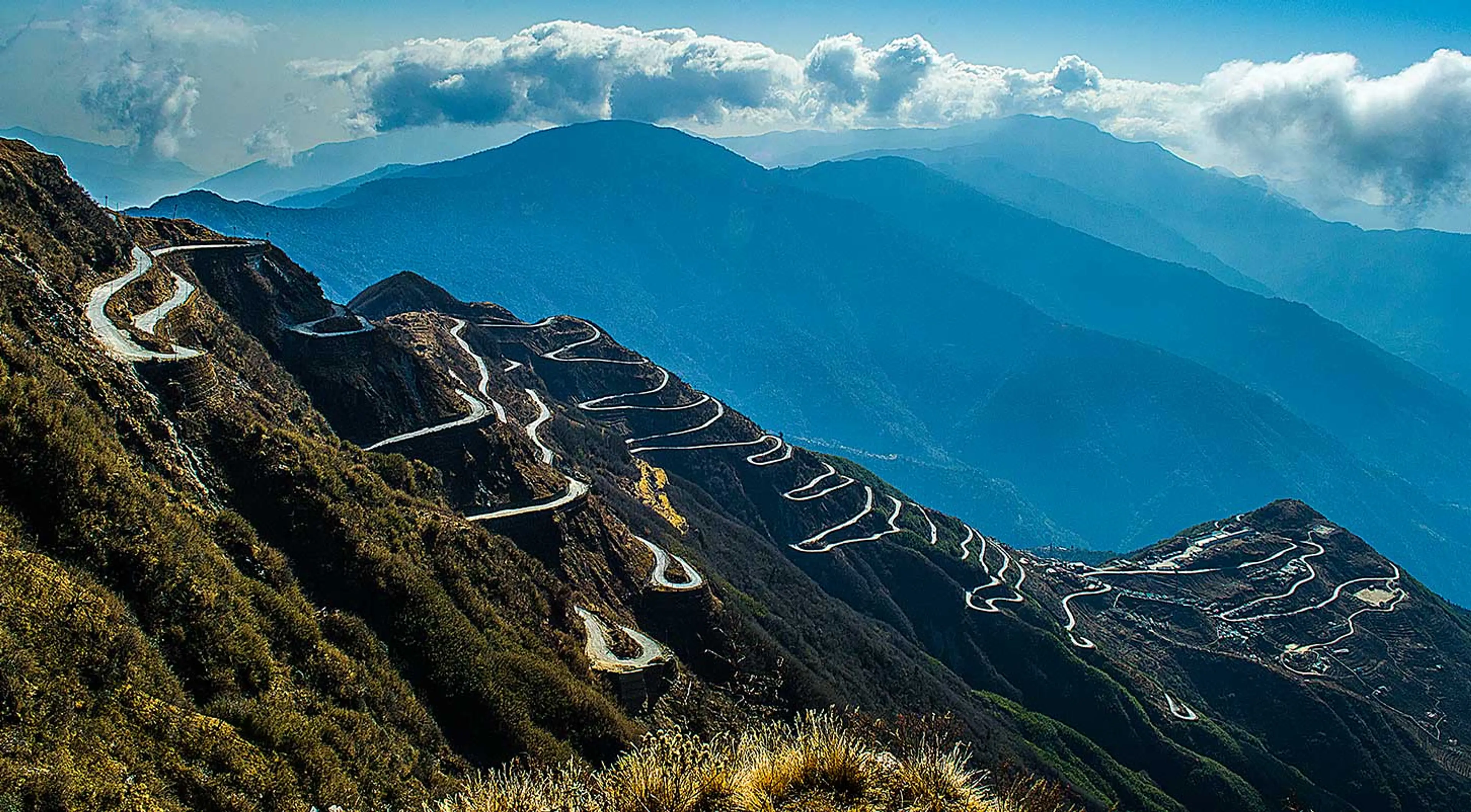
The climb beyond Zuluk Sikkim is what makes the Old Silk Route Sikkim truly unforgettable. The road rises through a series of tight switchbacks — famously known as the 32 hairpin bends.
These bends are not just a physical challenge; they are a defining feature of the Silk Route Sikkim. From above, the road appears as a winding ribbon across the mountain slope.
For those planning a Sikkim bike trip, this stretch offers one of the most thrilling riding experiences in India. It is also one of the most photographed sections of any Sikkim road trip.
Search queries like Zuluk hairpin bends view point often lead travellers to this exact moment — where effort meets reward.
Nathang Valley — The High-Altitude Plateau of the Silk Route Sikkim
Beyond Zuluk, the landscape changes dramatically. Forests give way to open terrain as the route approaches Nathang Valley, one of the highest points on the Old Silk Route Sikkim.
At over 13,000 feet, Nathang Valley is a defining highlight of the Silk Route Sikkim. The vast, treeless plateau creates a sense of scale that is difficult to describe.
For travellers on a Sikkim road trip, this section offers a pause — a moment to absorb the landscape. For those on a Sikkim bike trip, it represents both challenge and reward.
Those searching Nathang Valley altitude and travel guide often find this part of the journey to be the most memorable.
The Final Stretch — From Nathang Valley to Gangtok
The descent from Nathang Valley toward Gangtok completes the Old Silk Route Sikkim journey. This final section combines high-altitude riding with long descents, making it one of the most satisfying parts of a Sikkim road trip.
Passing through Kupup and Tsomgo Lake, the route gradually re-enters more accessible terrain. The transition from remote landscapes to a bustling town marks the completion of the Silk Route Sikkim experience.
For those following a complete Silk Route Sikkim itinerary, this final stretch ties together the entire journey.
Why the Old Silk Route Sikkim is More Than a Road Trip
The growing popularity of the Old Silk Route Sikkim reflects a broader shift in travel preferences. Travellers are increasingly looking for journeys that combine adventure with meaning.
Unlike conventional routes, the Silk Route Sikkim offers a layered experience — history, geography, and personal challenge. This is what makes it one of the most compelling options for a Sikkim bike trip or a Sikkim road trip.
For those exploring offbeat road trips in India Himalayas, this route stands out as both accessible and extraordinary.
A Journey That Stays Beyond the Ride
The Old Silk Route Sikkim is not defined by distance or difficulty. It is defined by what it leaves behind — the memory of a road shaped by history, and a landscape that changes with every turn.
For those choosing a Sikkim road trip or a Sikkim bike trip, this journey offers more than movement. It offers perspective.
NatureBeyond approaches journeys like the Silk Route not as routes to be completed, but as experiences to be lived — where every turn of the road carries history, and every journey is guided by a deep familiarity with the land and its stories.