
Cherrapunjee
Activities in Cherrapunjee

Trek to the Living Root Bridge, Umunoi - The valleys surrounding Sohra are home to several living root bridges, each shaped patiently over generations. Deep within the forest near the village of Nongkroh stands one of the oldest known examples, the Ummunoi Bridge. Built primarily upon a single massive root that stretches across the river, the bridge measures approximately 50 feet in length and remains remarkably strong, offering insight into traditional bio-engineering practices.MORE

Trek to Double Decker Root Bridge - The Umshiang Double Decker Root Bridge is among the most iconic sights near Cherrapunjee, and the trek to Nongriat village is equally memorable. Starting from Tyrna village, the trail begins with a steep descent of approximately 3000 concrete steps carved into the hillside. Along the route, expansive valley views and sightings of diverse bird species add to the experience.MORE

Drive to Umkar Root Bridge, Siej - Located about 15 kilometres from Sohra, the small village of Siej is home to a living bridge currently in the process of being grown. A short 10-minute walk from the village leads to the Umkar Root Bridge. The original bridge was washed away during a massive flood, and villagers have since begun carefully regrowing it using traditional methods.MORE

Trek to 'Splashing Park' - A gentle 6-kilometre trek through open landscapes offers a slower pace after the more demanding routes around Sohra. The trail passes through forested areas near Laitkynsew, ideal for birdwatching, and occasionally crosses paths with villagers tending vegetable patches. The route opens onto broad views overlooking Umwai Falls, Mawshamok, Umwai, and Mawlong villages, as well as the limestone mines of Ichhamati.MORE

Trek to Mawshamok by Lovers Road - This gentle, sloping 3-kilometre road winds through lush forested valleys, with distant waterfall plumes visible along the way. Quiet and relatively remote, the route has earned a reputation as a lovers’ road, offering an unhurried setting for a relaxed afternoon walk.MORE

Trek to the Warm Swimming Pool and Angling Spot - As river levels drop during winter, small pools form along the riverbanks, warmed by sunlight and surrounding rocks. These pools provide comfortable places to rest and cool off after longer hikes. The rivers near Sohra are well known for Himalayan game fish, making angling a popular activity for both locals and visitors.MORE

Village walk-in Nongwar village - Perched on a hillside overlooking the valley that leads toward the Bangladesh plains, Nongwar is a small, historic village with expansive views. The gentle ascent reveals waterfalls such as Nohkalikai, Dainthlen, and Laipateng Khohsiew, especially impressive during the monsoon season. Nongwar is home to the Khasi people and was among the earliest villages in the region to receive formal education.MORE

Swimming in Natural Pools - Meghalaya’s monsoon-fed landscape produces an abundance of streams, rivers, and pools, each displaying varying shades of blue and green. Swimming in these natural pools is among the most refreshing experiences the region offers. Locals are the best guides to safe swimming spots, many of which are naturally warmed by sunlight or sun-heated boulders.MORE

Bird watching - Birdwatching in Cherrapunjee is particularly rewarding due to the region’s varied terrain. Deep forested valleys, cultivated village edges, bamboo groves, mossy streams, and waterfalls create diverse habitats. The endemic Tawny-breasted Wren-babbler is found nowhere else in India and is frequently sighted here.MORE
Caving - Meghalaya is the only place in India where travellers can experience extensive cave exploration shaped by millions of years of monsoon activity. Vast limestone formations have given rise to some of the world’s most impressive cave systems, adorned with stalactites, stalagmites, and fossil-rich walls.MORE
Attractions in Cherrapunjee

ARWAH CAVE – SOHRA
Just before reaching Cherrapunjee town, a left turn down a rough track leads to the ancient Arwah Cave, one of the most intriguing natural attractions near Sohra. After passing the ticket counter, a scenic forest path guides visitors gently toward the cave entrance, offering a gradual transition from open landscape into subterranean space. Formed over millions of years through persistent water erosion of limestone rock, Arwah Cave reveals itself as a true Aladdin’s cave of geological and paleontological treasures.
Read More
Dainthlen Falls
Steeped in local Khasi mythology, Dainthlen Falls derives its name from the legend of a giant evil serpent known as Thlen, said to have lived here and terrorised local communities. According to the story, after the serpent was slain by a group of brave men, the waterfall burst forth from the site. This mythology lends the place a sense of power that is echoed in the thundering waters of Dainthlen Falls.
Read More
Mawsmai-Cave
Mawsmai Cave is one of the most visited limestone cave systems in Meghalaya and appears on nearly every Cherrapunjee itinerary. Although only a 150-metre stretch is open to the public, the route offers a highly engaging experience. The cave is well lit, making it accessible even to those uncomfortable with dark or enclosed spaces, while the lighting highlights the intricate limestone formations and natural colour variations within.
Read MoreNohsngithiang-Falls
Only a few minutes away from the caves lies the expansive view of the Mawsmai Falls, also known as the Seven Sisters Falls. Jagged limestone cliffs divide the cascading water into seven distinct streams, creating a dramatic visual effect. Locally called Nohsngithiang Falls, this waterfall exceeds 1000 feet in height, making it one of the tallest waterfalls in India.
Read More
Nongriat-Root-Bridge
In Cherrapunjee, bridges are not built; they are grown. Around 45 minutes by road from Sohra lies one of Meghalaya’s most extraordinary landmarks, the Umshiang Double-Decker Root Bridge. Reaching it requires a steep hike of approximately 45 minutes through the valley, involving a staircase of nearly 3000 steps, bamboo suspension bridges, and small waterfalls along the way, ultimately leading to Nongriat village.
Read MoreNohkalikai Waterfalls
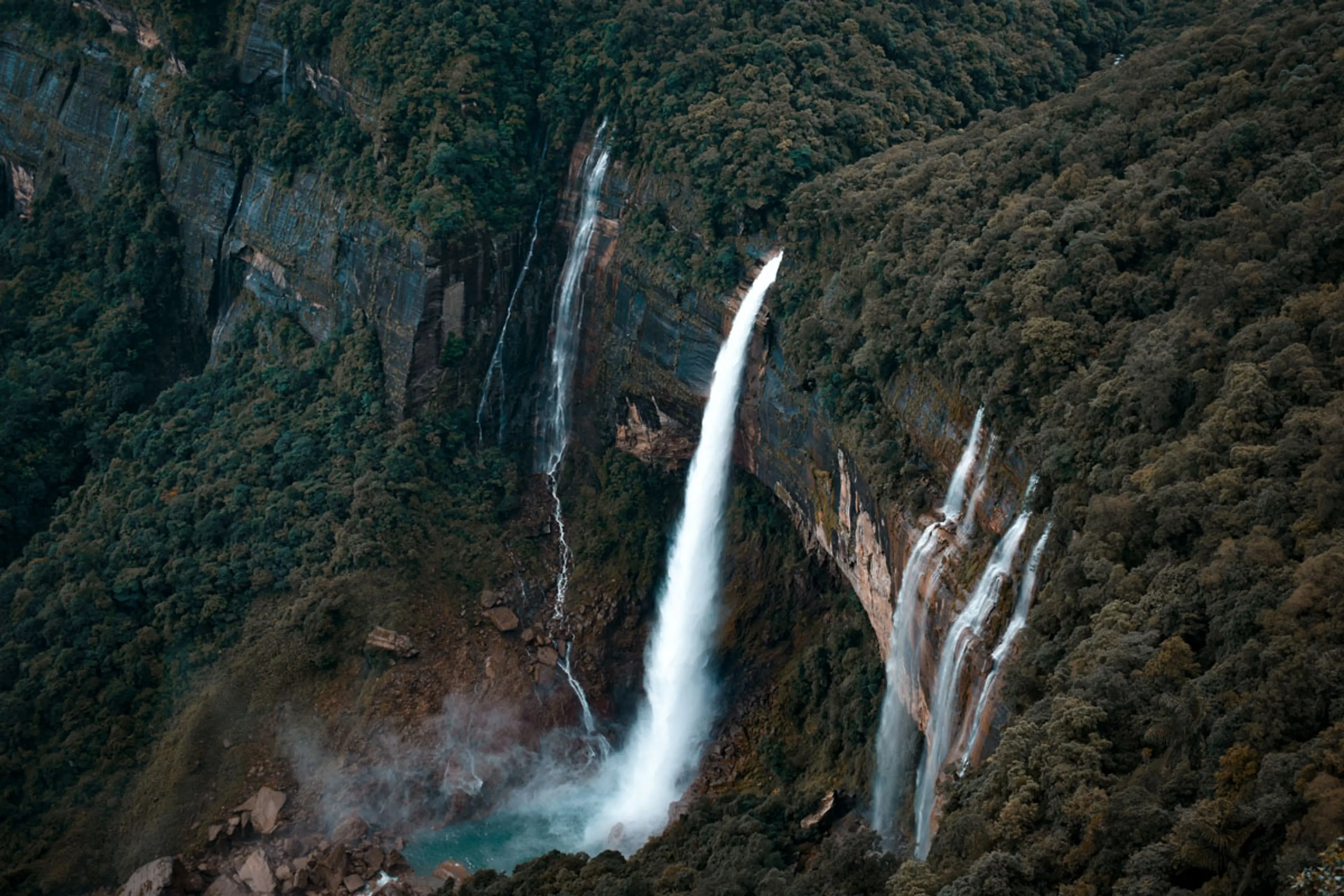
At over a thousand feet high, Nohkalikai is the tallest plunge waterfall in India and one of Cherrapunjee’s most iconic sights. The waterfall drops dramatically from a forest-covered cliff top, crashing onto the rocks below. While it is most powerful during the monsoon season, it retains substantial water flow even during drier months.
Read More
Cherrapunjee Local Weekly Market
Once every eight days, Cherrapunjee comes alive with the local lewbah, or ‘Big Market’. Scheduled so that Sunday church services are never disrupted, the market day draws hundreds of vendors and visitors into Sohra, many arriving by bus from surrounding areas. More than a trading space, the market functions as a major social event.
Read More
Thangkharang Park & Khynrem Falls
Located about 12 kilometres from Sohra, Thangkharang Park is a spacious, lush area ideal for quiet exploration. The park features rolling meadows, forested sections, landscaped gardens, and a greenhouse. At its edge, sheer cliffs open out to panoramic views of the Bangladesh plains and the nearby Kynrem Falls, which cascade down in three stages.
Read More
Khoh Ramhah/Pillar Rock
Khoh Ramhah, also known as Pillar Rock, is a massive rock formation shaped like the conical bamboo baskets traditionally used by the Khasi people. Positioned near the edge of Thangkharang Park, it stands against the backdrop of cloud-filled views stretching toward the Bangladesh plains.
Read More