
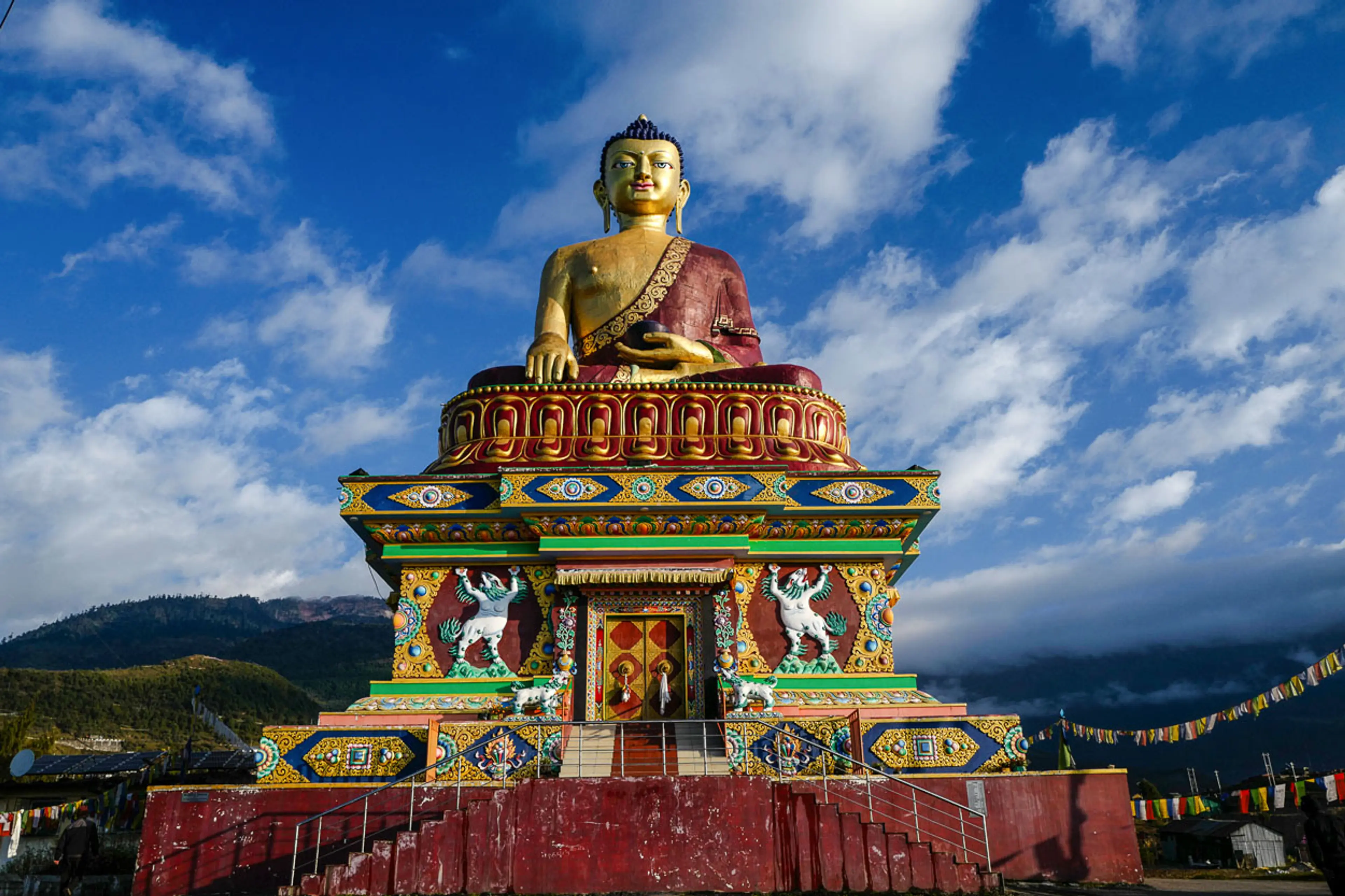
Tawang
A 335 years old fort-monastery in a spectacular landscape
Cradled between Bhutan in the West and Tibet in the North, Tawang sits high in the eastern Himalayas, defined by altitude, history, and spiritual scale. Anchored by its enormous 330-year-old fort monastery at nearly 3000 meters, Tawang is a prime destination for travellers exploring the West Arunachal Circuit and those seeking a deeper Himalayan travel experience. For international visitors using a Tawang travel guide, the region represents a rare convergence of geography and living Buddhist heritage, largely untouched by mass tourism.
With the Tawang Chu River flowing through the valley below, the approach to the town unfolds slowly, revealing wide mountain basins and layered ridgelines. The first distant view of the famous Tawang Monastery is often described as arresting. From afar, the vast white-and-red complex appears almost unreal, resembling a great ship suspended against the blue Himalayan sky. For many travellers planning a Tawang Monastery tour, this moment becomes the defining visual memory of the journey.
Tawang Monastery is the second largest monastery in Asia and the largest in India, making it a central landmark for those mapping out places to visit in Tawang. Founded in 1861 by Mira Lama Lodre Gyatso, the monastery has long served as a major centre of Mahayana Buddhism in the region. Its historical significance deepened in March 1959, when the Dalai Lama entered India through Tawang via Jemithang. Jemithang lies 100 kilometres from Tawang and is home to the Gresham Monastery, situated quietly on a hillside and still visited by pilgrims following this historic route.
Beyond its monasteries, Tawang is also shaped by its people and settlement patterns. According to a study conducted in 2011, the population of Tawang was 49,950, with an average density of 23 people per square kilometre. The Monapas are the principal inhabitants, preserving a distinct cultural identity expressed through architecture, dress, and religious practice. Smaller populations of Takpa and Tibetans also exist, contributing to the region’s layered social fabric. For travellers interested in cultural context rather than surface sightseeing, this human geography adds depth to any Tawang travel guide.
The broader landscape surrounding Tawang further reinforces its historical importance. The West Kameng and Tawang districts are rich in Mahayana monasteries, Chortens, and religious structures dating back to the 17th and 18th centuries. These sites, scattered across mountain passes and valleys, reflect centuries of spiritual continuity and regional exchange. Routes passing through Sela Pass Tawang remain essential not only for access but also for understanding how terrain shaped faith, movement, and settlement in this high-altitude frontier. Together, these elements form the foundation of many immersive Tawang tourism packages designed for travellers seeking culture, history, and Himalayan scale rather than conventional sightseeing.
Enquiry
Guests
Adults
Child
Rooms
Single
Double
Triple
Accommodation Standard
Expected Budget range for the whole tour
Preferred Destinations