
Bhutan
Locked between two giant nations — India and China — there is a tiny kingdom that rests peacefully among the soaring mountains and proudly declares itself “Happy.” For many travellers planning a bhutan trip, this spiritual land feels unlike any other. The legends say that long, long ago, The Precious Master — born inside a lotus that bloomed in a pristine lake — crossed the breadth of this land on the back of a flying tigress to salvage the religion of Lord Buddha from the subjugation of evil spirits.
The Thunder Dragon is the guardian of this land, where colourful prayer flags flutter endlessly, helping people communicate with the heavens. It is a place where secular power harmonises with spiritual belief, where the pursuit of Happiness precedes all other stately affairs — a truth felt deeply by anyone visiting bhutan tourist places that glow with myth and devotion. Welcome to Bhutan!
One of the smallest kingdoms in the world, land-locked by the mighty Himalayan ranges, Bhutan’s distant past is often shrouded in mystery and myth. Many historical records were lost to natural calamities and conflict-borne devastation. Yet whatever remains shows that Bhutan’s history, politics and stories are intricately intertwined with Tibet — another ancient mountain kingdom that guarded its secrets for centuries. For visitors exploring any bhutan tourist place, this blend of legend and history becomes part of the journey.
This fantastic Himalayan land opened its doors to the world only in 1974, welcoming the first international guests. Since then, tourism has grown into a vital part of the economy. Whether travellers arrive through a bhutan trip package from Mumbai or a bhutan trip package from Kolkata, they soon discover that Bhutan is not just a destination — it is an experience shaped by kindness, culture, and timeless rituals. The expansion of tourism has also created significant opportunities for the Bhutanese people, especially in guiding, hospitality, conservation, and cultural preservation.
As your travel advisors, our vision is to remain aligned with the kingdom’s philosophy — to ensure you experience “The Happiness of Vacationing.” Whether your bhutan trip focuses on festivals, dzong architecture, gentle hikes, birdwatching or meditative retreats, our curated itineraries allow you to immerse yourself in the heart of the kingdom. And if you wish to design your own path through bhutan best tourist places, simply share your preferences — we will gladly craft exclusive retreats, transport arrangements, and all necessary travel comforts.
Before planning, travellers should note the requirements of the bhutan travel visa, which ensure responsible, sustainable tourism aligned with Bhutan’s national philosophy of Gross National Happiness. With the right permits secured, Happiness truly becomes just a few clicks away.
Travel Destinations in Bhutan
Festivals
-BHutan_1678114778139.JPG&width=750&quality=75)
Bhutan is a land where stories breathe through mountains, monasteries, and the deep spiritual rhythm of its ancient celebrations. For travellers seeking a festive bonanza woven with myth, colour, and sacred tradition, bhutan festivals offer an extraordinary window into the kingdom’s soul. Each celebration follows age-old monastic calendars, and understanding bhutan festival dates becomes part of the journey itself. These are not mere events; they are living expressions of devotion, history, and identity — the essence of every bhutan main festival that draws visitors from around the world.
Below are four of Bhutan’s most iconic festivals, each a radiant thread in the country’s cultural tapestry.
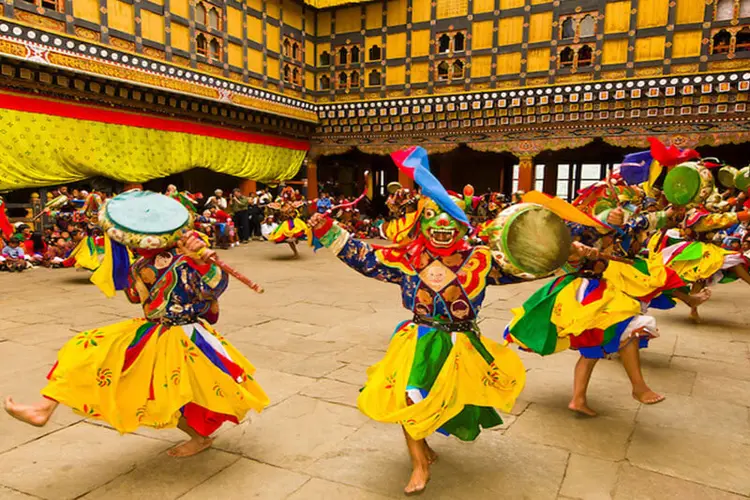
Among all bhutan festivals, Paro Tshechu stands as one of the grandest and most revered. Held each spring in the courtyard of Paro Dzong, this festival features sacred cham dances performed by monks and lay dancers in elaborate silk brocades and wooden masks. The highlight is the unfurling of the massive thongdrol — a giant sacred scroll believed to bless all who behold it at dawn.
Because Paro Tshechu follows the lunar calendar, travellers often check bhutan festival dates carefully before planning. As one of the bhutan main festival attractions, it draws pilgrims, families, and visitors who wish to experience Bhutan’s spiritual heart through rhythm, colour, and timeless ritual.
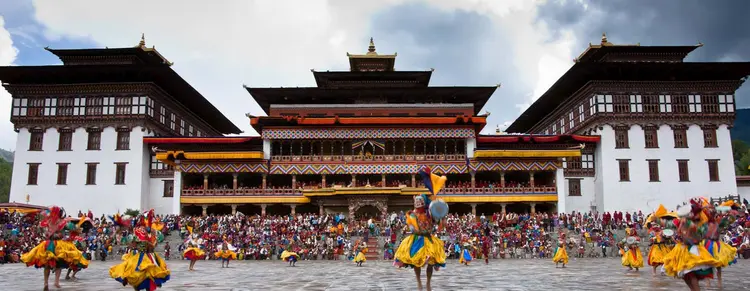
Held in the capital at Tashichho Dzong, Thimphu Tshechu is one of the largest and most attended events in Bhutan. Every autumn, the spacious courtyards fill with thousands dressed in their finest ghos and kiras, gathering to witness ancient mask dances that symbolise compassion, wisdom, and the victory of good over evil.
For travellers seeking a festive bonanza, this is among the best-known bhutan festivals, combining cultural spectacle with social celebration. As the festival peaks, the energy in Thimphu becomes electric — a reminder that tradition here is not preserved in museums, but lived.
In the former capital, Punakha hosts a pair of powerful celebrations. Punakha Drubchen reenacts the 17th-century battle in which Bhutanese forces repelled Tibetan invaders. The dramatic military-style performances, combined with drums and conch shells, make this festival uniquely gripping.
It is followed by Punakha Tshechu, a more ceremonial event filled with mask dances, blessings, and the unveiling of sacred appliqué art. Both festivals are central to Bhutan’s cultural identity and hold deep resonance for travellers seeking the historical heartbeat behind bhutan main festival traditions.
Held every November in Gangtey, this enchanting event celebrates the arrival of the endangered Black-necked Cranes. Students perform folk songs and masked dances honouring the birds, while villagers showcase local crafts and traditions.
For nature lovers and cultural travellers, this is one of the most unique bhutan festivals, blending conservation with community celebration. Its timing also encourages visitors to follow bhutan festival dates closely, as the cranes arrive with winter’s whisper.
Peoples
The soul of Bhutan lies not only in its mountains and monasteries but in the warmth, grace, and resilience of the bhutan people. Travellers often say that a journey through this kingdom feels like stepping into a living museum of compassion and tradition — a place where identity, spirituality, and community are inseparable. For visitors, meeting the people becomes one of the most unforgettable experiences of any Himalayan retreat.
The diversity of the bhutan population is one of the country’s most intriguing features. Three major communities — the Ngalop of the west, the Sharchop of the east, and the Lhotshampa of the south — form the cultural foundation of the kingdom. Yet despite their varied origins, they share a deep reverence for harmony, humility, and the cherished principles of bhutan culture. Their languages differ, their dress varies, and their landscapes shift from misty valleys to subtropical plains, but they remain united by values shaped over centuries.
Understanding bhutan population by religion offers travellers a deeper perspective on the country’s inner rhythm. The majority follow Vajrayāna Buddhism, a spiritual path that influences everything from architecture to daily rituals. Monks and common people alike practise meditation, seek blessings from local lhakhangs, and celebrate sacred festivals with colourful precision. In the south, large Hindu communities contribute their own rituals, adding another layer to Bhutan’s spiritual mosaic. This religious harmony is not symbolic — it is lived every day, forming the compassionate heart of bhutan culture.
As travellers move across the kingdom, they notice how closely the bhutan people remain connected to their land. Many live in rural villages where agriculture, forest stewardship, and traditional crafts form the backbone of daily life. Even in urban areas such as Thimphu, modernisation blends softly with legacy — locals continue to wear the gho and kira, speak regional dialects, and uphold customs passed down through generations. For visitors, these encounters become powerful reminders of how culture can evolve without erasing its roots.
Experiencing this depth of heritage often influences a traveller’s impression of bhutan trip expense. While Bhutan is known for its “high-value, low-impact” tourism model, guests soon understand that the expense supports cultural preservation, environmental protection, and the safeguarding of community life. Every interaction — from a farmer sharing red rice to a monk offering a quiet blessing — shows how the tourism philosophy helps sustain the vibrant lives of the bhutan people.
For anyone seeking a destination where humanity, heritage, and harmony breathe through every valley, the people of Bhutan offer a rare invitation: to witness not only a country, but a way of living shaped by kindness, spirituality, and timeless identity.
Foods
In Bhutan, food is more than sustenance — it is memory, landscape, identity, and warmth served on a wooden table. Travellers soon discover that bhutan food reflects the deep spirit of the kingdom: bold in flavour, humble in preparation, shaped by mountains and seasons. Every meal tells a story of terrain, climate, and ancestral heritage, making Bhutan’s cuisine one of the most genuine cultural attractions for visitors seeking authenticity.
Among all bhutan popular food, nothing stands taller than Ema Datshi — the fiery stew of local chillies and handmade cheese. Often called Bhutan’s unofficial national dish, this hearty preparation appears in nearly every household. Its aroma fills both rural kitchens and urban homes, drawing travellers into the heart of Bhutanese living. For many, tasting this bhutan famous dish becomes a defining moment of a Bhutan journey, a reminder that here, chillies are not spice but vegetable, an essential part of everyday life.
The country’s geography has shaped both appetite and agricultural tradition. In temperate valleys, red rice forms the base of most meals, its nutty flavour pairing perfectly with cheese stews, sautéed greens, and seasonal vegetables. In colder regions such as Bumthang, buckwheat takes prominence, appearing as noodles, pancakes, and breads — classic bhutan food items that reflect both creativity and necessity. Maize and millet also play their part in rural communities, showing how Bhutanese families adapt their cuisine to changing altitudes and climates.
Visitors often ask about bhutan food vegetarian options, and they are pleasantly surprised. Bhutanese cuisine is rich in vegetables, mushrooms, wild greens, bamboo shoots, and farmhouse cheeses. Many traditional dishes, especially datshi variations — such as potato datshi or mushroom datshi — are naturally vegetarian. In many homes and restaurants, vegetarian meals are not “alternatives” but everyday staples, crafted with the same care and depth of flavour as meat-based dishes. For travellers seeking wholesome, earthy meals shaped by mountain produce, Bhutan is unexpectedly welcoming.
Yet meat also holds a place in Bhutanese kitchens. Pork, beef (often dried), chicken, and yak meat are cooked in hearty stews designed to withstand harsh winters. Preservation techniques such as drying and fermenting reflect centuries of adaptation to high-altitude living. These robust flavours enrich the diversity of bhutan food items, ensuring that every region offers its own distinct culinary experience.
What makes the cuisine truly captivating is its connection to land and culture. Meals are slow, warm, and communal. Locals pour butter tea in homes warmed by wood stoves; families share red rice and seasonal greens; monks serve simple offerings shaped by monastic discipline. Travellers quickly realise that enjoying bhutan popular food is not simply about taste — it is a way to understand the kingdom’s heart, its people, and its stories.
In every valley, at every table, bhutan food invites you to savour the heritage of a kingdom where flavour and tradition live side by side.
Climates
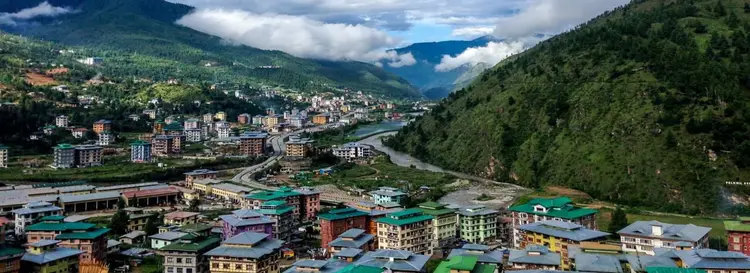
The Kingdom of Bhutan breathes in rhythms shaped by altitude, wind, cloud and sunlight. Its mountains rise like ancient guardians, sculpting a climate that shifts gently from subtropical warmth to alpine cold within a single day’s journey. For travellers seeking to feel the kingdom through its sky and seasons, knowing the bhutan best season to visit is part of the magic — because every valley carries its own story of rain, wind, and quiet winter light.
The beauty of bhutan weather lies in its extraordinary diversity. In the south, warm breezes sweep through lush forests, carrying the scent of monsoon rain. In the central valleys — from Thimphu to Paro, Punakha to Trongsa — the climate becomes cool and temperate, offering crisp mornings and sunlit afternoons. Far in the north, snow covers the land for much of the year, and Himalayan winds whisper across glaciers and high-altitude passes. This remarkable range, shaped entirely by elevation, makes travellers pause and look upward at a sky that is always shifting.
Visitors often check bhutan weather now before travelling, eager to match their journey with the kingdom’s natural moods. During summer months, the Southwest Monsoon paints the land emerald, bringing heavy rain between June and September. Valleys fill with mist, waterfalls multiply, and hillsides glow with fresh greenery. Though monsoon months are dramatic and beautiful, they are less favoured for treks — making this period appealing mainly to those seeking solitude and deep landscape photography.
When travellers ask about the best time to visit bhutan, the answer is almost always shaped by spring and autumn. From March to May, rhododendrons bloom across mountain slopes, valleys warm gently, and the air fills with clarity. Autumn, from late September to November, brings calm skies, mild temperatures, and the clearest mountain views of the year. These months are considered the bhutan best season to visit not only because of stable weather, but because major festivals also unfold during this time, drawing visitors into the heart of Bhutanese culture.
Winter in Bhutan carries its own quiet charm. From November to February, crisp air settles over the highlands, and the sky remains clear and blue. The central valleys become cool but comfortable, making it a peaceful season for travellers seeking calm, open landscapes. Meanwhile, the southern plains remain mild, allowing visitors to experience forests, wildlife sanctuaries and warm rural life. Many travellers check bhutan weather now during winter to decide whether they wish to explore snow-dusted monasteries or enjoy the gentler warmth of subtropical foothills.
For those who travel not just to see a place but to feel its seasons, bhutan weather becomes a guide, a storyteller, and an invitation. Whether wrapped in autumn gold, monsoon mist, or winter morning light, Bhutan’s climate shapes every journey into something memorable — reminding visitors that the sky, too, is part of the kingdom’s spirit.