
Singalila to Goechala — The Ultimate Trekking in India Himalayas Experience
There is a moment in the high mountains when the landscape stops feeling like geography and begins to feel like scale itself. On the Singalila ridge, that moment comes quietly — not as a dramatic arrival, but as a gradual unfolding of horizon after horizon. This is not simply trekking in India Himalayas; it is a layered journey across ecosystems, altitudes, and perspectives that redefine what himalaya trekking India truly means.
For travellers seeking more than a standard route, the combined Singalila–Dzongri–Goechala corridor represents one of the most immersive Kanchenjunga trek experiences available today. It is widely regarded among the best treks eastern himalayas offer, not because of a single viewpoint, but because of how the terrain evolves — forest to ridge, ridge to alpine, alpine to glacial silence.
This is where Goechala trek and Singalila trek stop being destinations and become transitions.
The Ridge That Changes Perspective — Singalila Trek
The Singalila ridge is often introduced through photographs — a narrow trail, clouds rolling below, peaks rising in alignment. But walking it reveals something deeper. The geography itself creates continuity. The trail follows the Indo–Nepal border, allowing trekkers to experience one of the most expansive remote treks in India Himalayas without extreme technical demands.
Along this route, the idea of trekking sikkim begins to shift. It is no longer confined to a region — it becomes part of a wider Himalayan system. The forests here are dense, layered with bamboo and rhododendron, and in spring they transform into one of the most visually intense corridors within sikkim trekking.
For those trying to explore Singalila ridge trekking experience, this section offers a balance rarely found — accessibility combined with visual scale. Many travellers also compare trekking destinations in the Himalayas at this stage, realising how this route differs from more crowded Himalayan circuits.
From certain points, you encounter one of the most iconic alignments in the world — Kanchenjunga, Everest, and Makalu forming a continuous skyline. It is moments like these that place this route among the least crowded treks in india that still deliver unmatched visual impact, especially during the best time for trekking in india himalayas when visibility stretches endlessly.
Entering Kanchenjunga’s Domain — Dzongri and Beyond
Beyond the ridge, the trail begins to deepen. The transition toward Dzongri marks a clear shift in terrain and altitude. Forest density increases, trails narrow, and elevation gain becomes more sustained. This is where the journey begins to align more closely with the Kanchenjunga trek route, moving into the protected ecosystem of Kanchenjunga National Park.
For trekkers preparing for this stage, it becomes essential to understand high altitude trekking preparation india, as the climb introduces thinner air and more demanding terrain. Dzongri itself is not just a campsite — it is a vantage point that introduces trekkers to scale in a different way.
Here, many begin to plan a trek in India properly, recognising that this is no longer a casual hike but a structured Himalayan journey. The region also draws those looking into trekking Kanchenjunga national park as a complete ecosystem experience rather than just a viewpoint destination.
Early mornings in Dzongri often define the emotional core of trekking in Sikkim Himalayas, where light reveals the massif in full clarity and transforms the entire landscape.
Goechala — The Edge of the Mountain System
The final approach to Goechala is not dramatic in the conventional sense. There are no sudden reveals, no theatrical summits. Instead, the landscape strips itself down. Vegetation fades, terrain becomes more glacial, and silence becomes part of the experience.
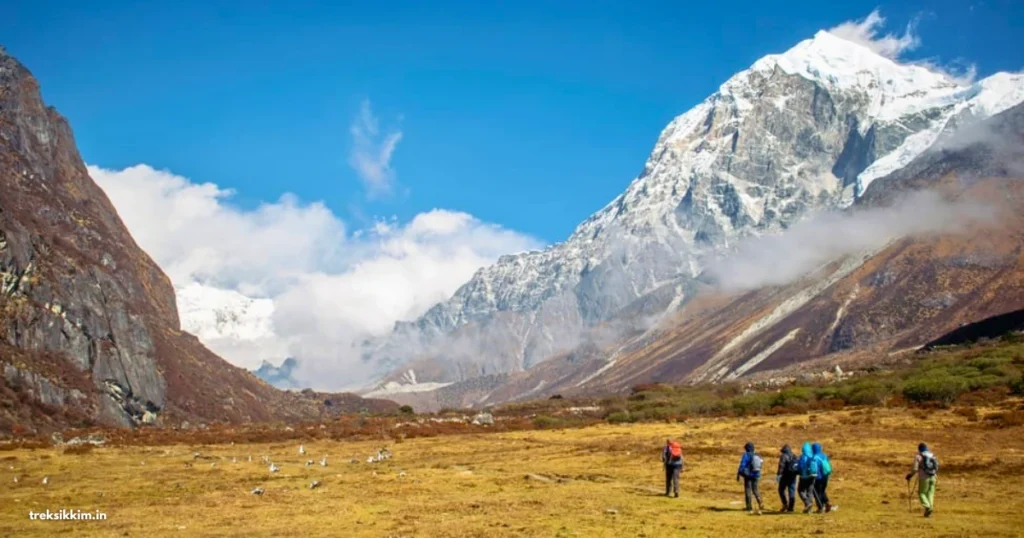
At approximately 4,800 meters, the viewpoint places you within direct proximity of the Kanchenjunga massif. Those researching the Goechala trek route details often underestimate how immersive this final section feels.
Among all routes within himalaya trekking India, this moment defines the Goechala trek as one of the most complete high-altitude experiences available. For travellers seeking remote trekking experiences india, this section offers both isolation and intensity.
It is here that the journey shifts — not in terrain, but in perception. The mountain is no longer distant; it becomes immediate, almost overwhelming in presence.
Why This Is Among the Most Complete Treks in India
Many treks offer a highlight — a summit, a lake, a pass. Few offer progression. The Singalila–Goechala combination stands out because it delivers a full narrative of trekking Sikkim within a single journey.
Travellers often look into trekking in india Himalayas guide content before choosing routes, but few realise how important progression is until they experience it. From accessible trails to alpine exposure, the journey unfolds in layers.
This is why it consistently ranks among the best treks in Sikkim India and continues to appear in discussions around Himalaya trekking routes india. It is not just about reaching a destination — it is about moving through a complete ecological system.
The Experience Beyond the Trail
What often goes unspoken in discussions of the Singalila trek or Goechala trek is the human rhythm that runs alongside the landscape. Tea houses, local guides, and small settlements create continuity between terrain and culture.
Travellers seeking offbeat trekking routes india find this region particularly rewarding because it retains a sense of authenticity. Unlike more commercialised trekking circuits, interactions here feel organic and unstructured.
For international visitors, this becomes an essential layer of the experience. It is not just about physical endurance — it is also about engaging with cultural experiences in Himalayas India and understanding the rhythm of life in mountain regions.
Seasonal Windows and Trekking Conditions
Timing plays a critical role in shaping this journey. The most favourable windows fall between April–May and October–November, when weather and visibility align effectively.
Spring introduces rhododendron blooms across the Singalila section, while autumn provides clarity and stability. Those researching weather conditions himalaya trekking quickly realise how important seasonal timing is for overall experience quality.
Understanding best season for Goechala trek also helps optimise the journey, especially when balancing visibility, temperature, and trail conditions. Administrative aspects such as trekking permits Sikkim India also play a role in planning.
Positioning This Trek in the Global Context
Globally, trekking destinations often fall into clear categories — technical climbs, cultural routes, or scenic trails. The Singalila–Goechala route resists that classification.
Travellers frequently compare trekking destinations in the Himalayas when deciding between India and Nepal. What sets this route apart is its balance — it offers depth without extreme technical barriers.
For those exploring trekking vs hiking India Himalayas, this journey sits in a unique space — demanding enough to feel earned, yet structured enough to remain accessible.
A Journey That Expands With Every Step
In the end, what defines this journey is not a single moment or location. It is the accumulation of transitions — forest to ridge, ridge to alpine, movement to stillness.
For those willing to engage deeply, it becomes more than just trekking in India Himalayas. It becomes a layered experience of landscape, scale, and movement.
And in that sense, the Singalila–Goechala corridor is not just a trek — it is one of the most complete expressions of Himalaya trekking India available today.