
Bespoke Village Trails
From undefined/dayAn Experiential walking & Farmhouse tour in rural off-beat Sikkim
Destination Covered || Pelling * Kewzing * Rumtek
Introduction || Most visitors to Sikkim follow the same well-worn circuit: Gangtok, Tsomgo Lake, Lachung. This tour goes somewhere different. The Bespoke Village Trails journey moves through West and South Sikkim on foot and by farmhouse, visiting destinations that remain genuinely off the mass tourism map — places where the forests are uncleared, the monasteries unhurried, and the welcome from village families entirely unhurried. For international travellers seeking authentic rural India in a Himalayan setting, this 7-day Sikkim village and homestay tour offers an experience that no standard Sikkim package comes close to replicating.
Pelling opens the journey with an immediate declaration of what lies ahead — an extraordinarily close panoramic view of the Kanchenjunga massif, the world's third-highest peak, framed by forested ridgelines and open Himalayan sky. The area's monasteries are among the most significant in Sikkim. A hike through bird-rich forests leads to Sanga Choling Monastery, one of the oldest gompas in the state, where species such as the Red-Faced Liochichla and Grey-Headed Woodpecker reward patient walkers long before the monastery's mountain panorama comes into view. Pemayangtse — built over 300 years ago by Lama Lathsun Chempo and one of the most revered monasteries in the entire region — and the ancient ruins of Rabdentse, once the second capital of the Choygal kingdom of Sikkim, add layers of Buddhist monastery culture and Himalayan history that few travellers ever encounter at this depth.
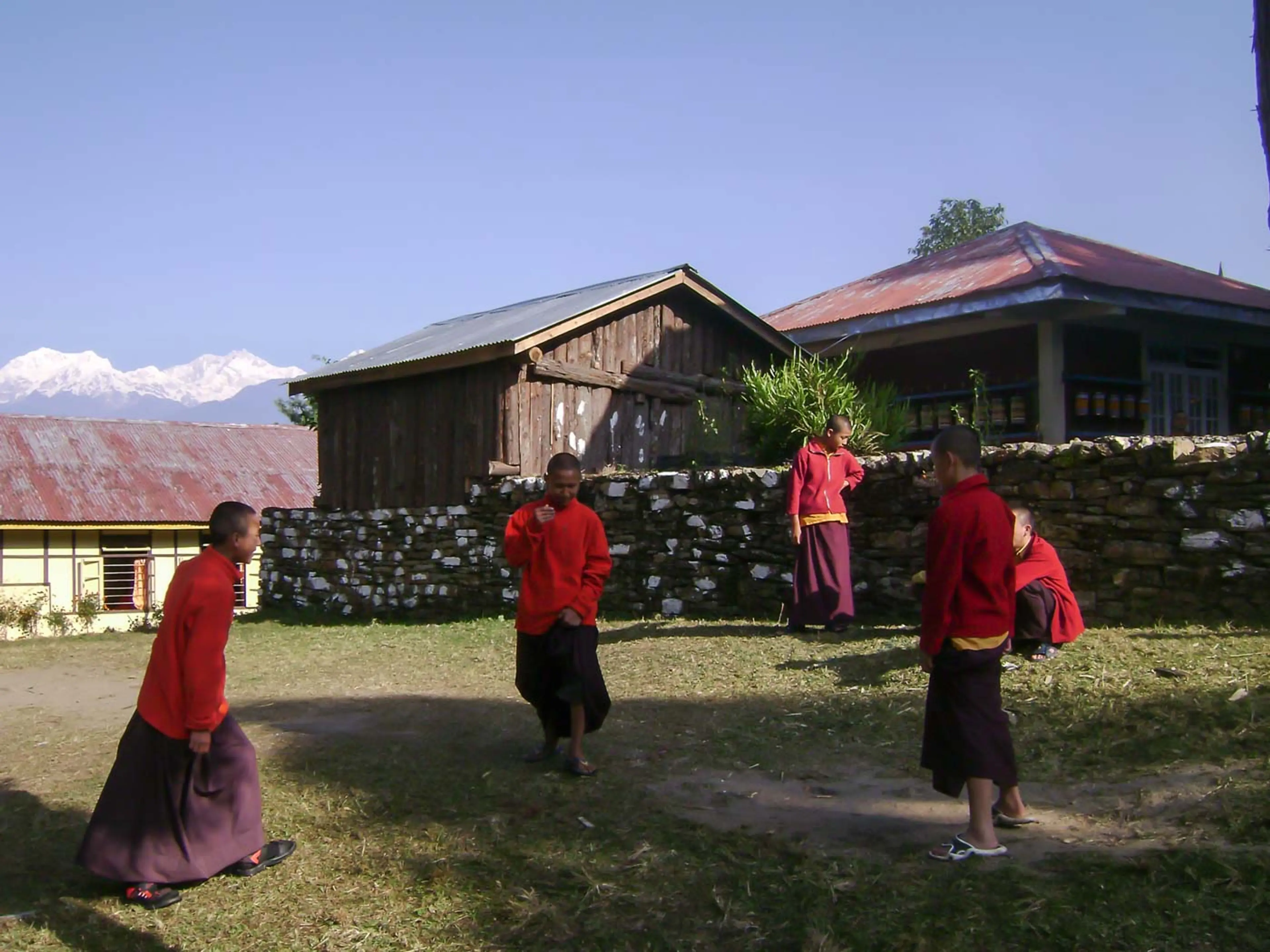
From Pelling, the route descends to Kewzing — a traditional Bhutia village in South Sikkim that represents the heart of this tour's community village tourism experience. The welcome here is immediate and genuine: a traditional lunch prepared by the villagers, an afternoon village walk through Kewzing's terraced fields and small lanes, and the first night in a family homestay where the rhythm of rural Sikkim unfolds at close quarters. Mornings begin in the homestay kitchen over a traditional breakfast, before guided walks to the village monastery introduce the local monk — a conversation about Buddhist philosophy conducted not in a visitor centre but in a living place of practice.
The Kewzing days accumulate experience quietly: visits to the village primary school where an impromptu class or football game with the children creates moments of connection that no organised activity can manufacture; observation of daily farming and household rhythms; and an afternoon in the village's celebrated hot stone bath — a traditional Sikkimese spa where water heated by river stones and infused with medicinal herbs draws minerals deep into the body in a way that has been practised in these hills for centuries. Evenings belong to the community — a bonfire, a cultural performance of local music and dance, and a home-cooked dinner of fully organic Sikkimese cuisine prepared from vegetables grown on the same farm. For those interested in learning to cook, the kitchen is open.
The final chapter moves to Rumtek in East Sikkim, where the landscape shifts to terraced paddy slopes and a serene countryside framing one of the most important Buddhist sites in the Himalayas. Rumtek Monastery — the Dharma Chakra Centre, the largest gompa in Sikkim and an almost exact replica of the original Kagyu headquarters in Tibet — was built in 1960 by the 16th Karmapa following the Chinese annexation of Tibet. Its prayer hall, adorned with intricate murals, thangkas, and silk paintings, and its golden stupa housing the sacred relics of the Karmapa, make it a place of profound spiritual weight. The Shri Nalanda Institute for Higher Buddhist Studies adjacent to the monastery adds scholarly depth to the visit.
Accommodation at Rumtek is in an eco-resort run by a host family, where the farmhouse pace of rural Sikkimese life continues: mornings watching the cow milking, afternoons learning about organic farming in the Himalayas, short hikes into the surrounding hills to meet neighbours and observe the village, and evenings around a barbeque under mountain skies. This is slow travel in Sikkim at its most complete — a week that moves through monasteries, villages, forests, and farmhouses, accumulating a picture of Himalayan rural life that no sightseeing tour can approach. Best experienced between October and April, when skies are clear and mountain views at their most expansive.
Best Months || October to April