
Understanding the Sundarbans Mangrove Ecosystem: Tidal Ecology, Human Adaptation, and Wildlife Realities in Eastern India
For many foreign travellers, the idea of a forest is stable—rooted land, fixed trails, predictable boundaries. The Sundarbans challenges that assumption entirely. Here, land is temporary, water is dominant, and survival—whether human or ecological—is defined by constant adjustment.
Located in the Ganges–Brahmaputra delta, the Sundarbans represents the world’s largest mangrove ecosystem. But more importantly, it is one of the few places where environmental processes are not hidden—they are visible, daily, and unavoidable. For those interested in cultural travel eastern india, understanding this region requires looking beyond scenery and into systems.
The Mechanics of a Tidal Landscape
The Sundarbans is not a fixed geographical space—it is a shifting interface between river and sea. Freshwater flowing from the Himalayas meets tidal saltwater from the Bay of Bengal, creating a brackish environment that continuously alters the landscape.
Twice a day, tides reshape the terrain. Mudflats disappear, channels expand, and islands partially submerge. What appears as land in the morning may be water by evening. This instability defines the ecological structure of the region and makes it fundamentally different from inland forests.
Key Physical Characteristics of the Sundarbans
|
Feature |
Explanation |
|
Water Composition |
Mix of freshwater and seawater (brackish) |
|
Terrain |
Mudflats, tidal creeks, fragmented islands |
|
Soil Type |
Saline, waterlogged, unstable |
|
Daily Change |
Land submerged and exposed with tidal cycles |
|
Accessibility |
Primarily boat-based movement |
The vegetation reflects this instability. Mangrove trees have evolved specialized structures—such as aerial roots—to cope with oxygen-poor soil. These roots rise above the ground, allowing the plant to absorb oxygen even when submerged. Many species also filter salt through their leaves, maintaining internal balance in a saline environment.
Another important characteristic is sediment movement. Rivers constantly deposit silt, while tides redistribute it. This creates new landforms while eroding others, resulting in a landscape that is never static. For a foreign traveller, this can be disorienting, as maps and physical reality do not always align perfectly.
For those accustomed to fixed himalayan landscapes, this environment offers a stark contrast. Here, permanence is replaced by flux, and stability is replaced by resilience.
Biodiversity Under Conditions of Extremity
The Sundarbans is often introduced through its wildlife, but its real significance lies in how life persists under extreme ecological constraints. Every organism in this ecosystem operates within narrow environmental limits—balancing salinity, water availability, and terrain instability.
The region supports a wide range of species, but unlike more stable ecosystems, biodiversity here is not about abundance—it is about specialization. Each species is finely tuned to survive within specific conditions.
Ecological Distinctiveness of the Sundarbans
- Only mangrove ecosystem globally supporting a tiger population
- Strong salinity gradient shaping species distribution
- Continuous interaction between terrestrial and aquatic food chains
- Critical breeding and nursery ground for marine species
The Royal Bengal Tiger, often associated with the region, demonstrates this adaptation clearly. Unlike inland tigers, Sundarbans tigers are known to swim between islands, navigate tidal creeks, and adjust hunting strategies based on water levels.
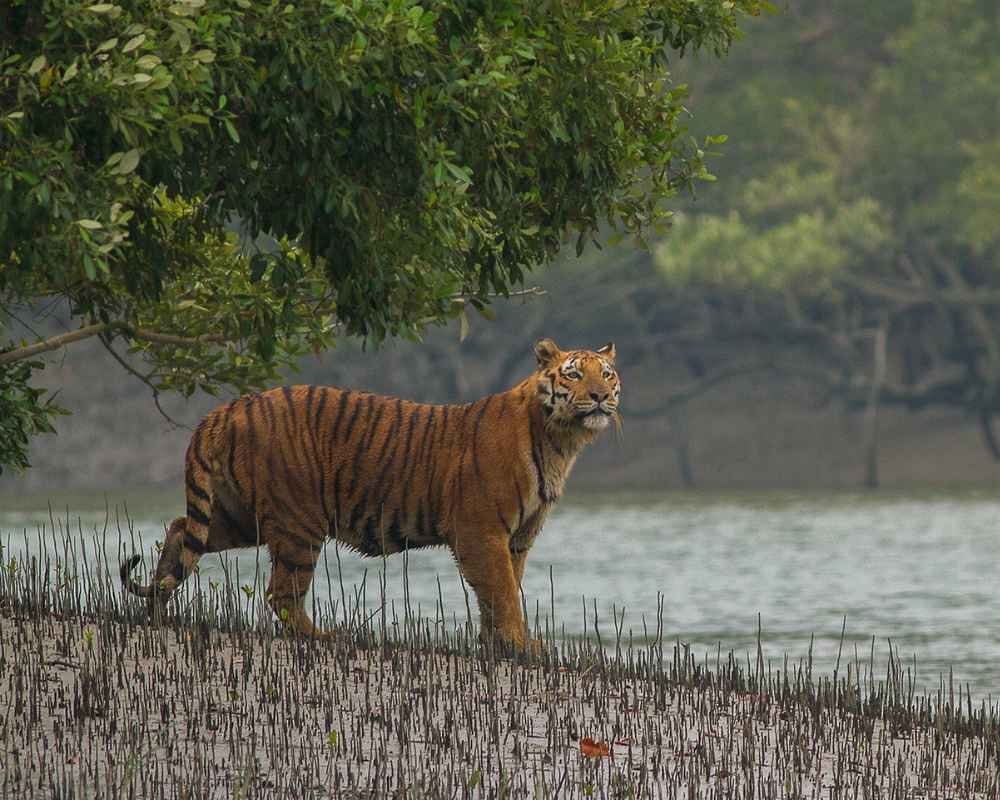
Similarly, fish and crustaceans depend on tidal cycles for breeding, while bird species—both resident and migratory—use the region as a seasonal habitat. This creates a dynamic system where life is synchronized with environmental rhythms.
Biodiversity Structure (Simplified)
|
Category |
Adaptation Pattern |
|
Plants |
Salt tolerance, aerial root systems |
|
Mammals |
Amphibious movement, flexible territory |
|
Birds |
Migration linked to seasons and tides |
|
Aquatic Life |
Breeding aligned with salinity cycles |
For those exploring sundarbans wildlife, the key realization is that biodiversity here operates under constraint, not abundance. This makes the ecosystem both fragile and highly efficient.
Another important dimension is ecological interdependence. Disruption in one element—such as salinity increase or sediment change—can cascade across the system. This interconnectedness is what makes the Sundarbans ecologically significant on a global scale.
Human Life Within a Tidal System
Perhaps the most complex aspect of the Sundarbans is not its wildlife, but its human presence. Millions of people live along the periphery of this ecosystem, navigating daily life within an environment defined by uncertainty.
Villages are typically located on embankments—raised structures built to prevent tidal flooding. However, these embankments are vulnerable to cyclones, erosion, and rising sea levels. Breaches are common, and rebuilding is a continuous process.
Core Features of Human Adaptation
- Dependence on fishing, honey collection, and forest produce
- Limited agricultural productivity due to saline soil
- Exposure to extreme weather events such as cyclones
- Reliance on waterways for transport and communication
Human–Environment Interaction
|
Challenge |
Adaptation Strategy |
|
Flooding |
Embankment construction and maintenance |
|
Salinity |
Crop adaptation and reduced farming |
|
Wildlife Threat |
Controlled access to forest zones |
|
Isolation |
Boat-based mobility systems |
Human life here is defined by negotiation—with water, with land, and with wildlife. Encounters with tigers, though relatively rare, are a known risk, particularly for those entering forest areas for livelihood activities.
For travellers seeking authentic travel experiences india, this environment offers insight into a form of coexistence that is neither idealised nor entirely conflict-driven. It is pragmatic, adaptive, and often precarious.
Understanding this context is essential. Without it, the Sundarbans may appear as a remote wilderness. With it, it becomes a lived landscape shaped by continuous human effort.
Interpreting the Sundarbans as an Ecological System
To understand the Sundarbans fully, one must move beyond the idea of visiting a place and instead observe a system in motion.
This system is defined by:
- constant environmental change
- ecological specialization
- human dependence on unstable resources
Unlike conventional destinations, the Sundarbans does not offer fixed points of reference. Instead, it requires attention to processes—how water moves, how vegetation adapts, how communities respond.
For those exploring cultural differences east india, this region represents an extreme example of how environment shapes culture. Here, livelihoods, settlement patterns, and social structures are directly influenced by ecological constraints.
It also challenges expectations of travel. There are no predictable routes, no guaranteed wildlife sightings, and no static landscapes. Instead, there is variability—and within that variability, insight.
This makes the Sundarbans particularly relevant for those interested in slow travel eastern himalayas and adjacent regions, where the emphasis shifts from coverage to comprehension.
Why This Matters for Foreign Travellers
For international visitors, the Sundarbans offers a perspective that differs significantly from more conventional travel experiences in India.
Rather than focusing on monuments or cities, it presents:
- a landscape defined by change
- an ecosystem shaped by adaptation
- a society structured around environmental negotiation
This makes it especially valuable for travellers seeking depth rather than breadth. It also reframes travel as an act of understanding rather than consumption.
In this context, the Sundarbans becomes more than a destination—it becomes a case study in how life persists under constraint.
Reflecting Back
The Sundarbans does not reveal itself immediately. Its complexity unfolds gradually—through patterns of water, vegetation, and human activity.
Here, land is uncertain, and water is constant.
Here, survival is not guaranteed—it is maintained.
And in observing this balance, one begins to understand not just the region, but the broader relationship between environment and life itself.