
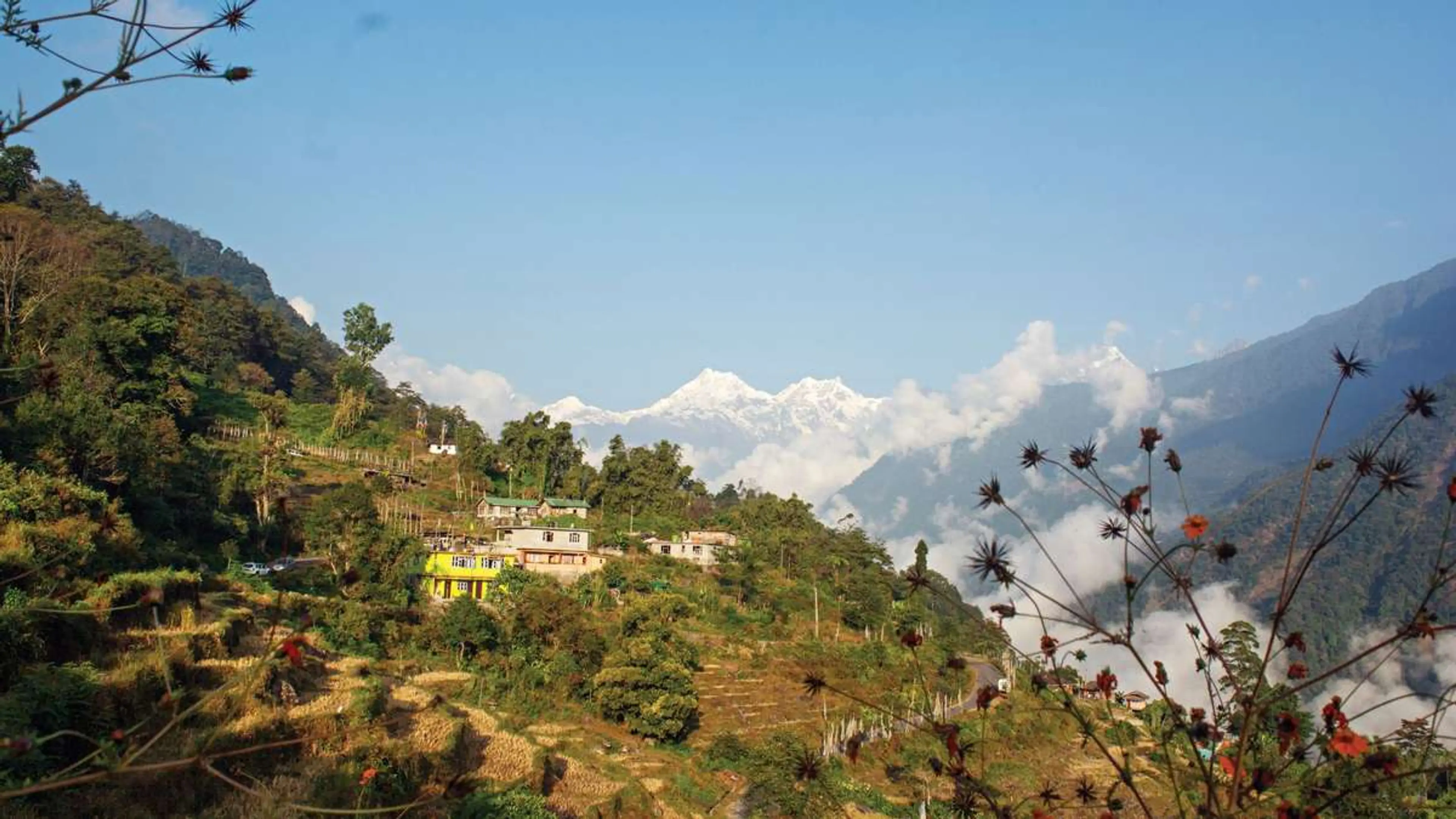
Living With the Lepcha Landscape: A Slow Journey Through Dzongu
Dzongu does not present itself as a destination waiting to be discovered. There are no dramatic gateways, no sense of arrival engineered for visitors, and no visual shorthand that immediately explains where one is. Instead, the landscape opens gradually, revealing itself through movement, repetition, and time. For travellers accustomed to structured itineraries and clearly marked attractions, this absence can feel unsettling. Yet it is precisely this quality that gives Dzongu its depth. What unfolds here is not a place to be consumed, but a homeland that allows only partial access.
Situated in a protected valley of North Sikkim, Dzongu is the ancestral territory of the Lepcha people. Travel within this region is shaped by rivers, forests, and agricultural rhythms rather than by tourism infrastructure. Movement is slow because it must be, and restraint is embedded into everyday life. In this context, Dzongu travel becomes less about where one goes and more about how one learns to remain present within a living cultural landscape that was never designed for outsiders.
Dzongu as a Cultural and Ecological Sanctuary
Dzongu Is Not a Destination, but a Lived Geography
For the Lepcha community, Dzongu is not understood as scenery or territory in the abstract. It is a lived geography, shaped by ancestry, memory, and obligation. Rivers, ridges, forests, and cultivated land are woven into a cultural system that assigns meaning to space through stories, taboos, and inherited responsibilities. The land is not approached as property, nor even as heritage to be preserved at a distance, but as something that requires daily negotiation and care.
The Teesta River and its tributaries are central to this understanding. They influence settlement patterns, agricultural cycles, and seasonal movement, while also carrying spiritual significance that governs how they are approached. Forests are similarly differentiated, not by density or altitude alone, but by cultural role. Some areas are entered routinely, others only at specific times, and certain zones remain untouched altogether. These distinctions are rarely visible to visitors, yet they quietly structure life within the valley.
Villages in Dzongu appear where water access, arable land, and lineage intersect. Paths emerge from necessity rather than design, following routes shaped by daily use over generations. For visitors, Dzongu travel is therefore an exercise in orientation rather than exploration. It reflects the logic of a Lepcha cultural landscape and aligns with broader understandings of indigenous cultural landscapes and cultural geography, where identity and terrain remain inseparable rather than visually curated.
Everyday Life in a Restricted Himalayan Region
Daily Rhythms, Seasonal Work, and the Meaning of Slowness
Daily life in Dzongu unfolds through rhythms that leave little space for urgency. Agricultural work, forest gathering, and domestic routines are organised around seasonal necessity rather than efficiency. Weather patterns, daylight, and the readiness of people determine when tasks begin and end. Walking is central to everyday movement, connecting homes, fields, rivers, and neighbouring villages into a continuous lived space.
For travellers, adapting to this rhythm requires patience and attentiveness. Plans shift easily, not out of disorder but because priorities change with circumstance. A delayed meal may follow extended work in the fields; a planned walk may be postponed because fog has settled into the valley. This elasticity of time is not accidental. It reflects a way of living in which human activity remains responsive to land and climate rather than imposed upon them. Travellers drawn to slow travel in the Himalayas often find that Dzongu embodies this philosophy without naming it, offering slowness as a lived condition rather than a curated experience.
What becomes visible through these rhythms is a pattern of continuity. Tasks repeat daily and seasonally, yet they are never static. Each year brings slight adjustments, shaped by rainfall, soil conditions, and collective decision-making. Observing these processes reveals human–environment relationships that are maintained through attention rather than control. Dzongu’s pace invites visitors to witness place-based ways of living in which balance is sustained through repetition, cooperation, and restraint, rather than through constant change or optimisation.
What Responsible Travel Looks Like in Dzongu
Entering With Permission: Travel Ethics in Lepcha Land
Dzongu’s restricted status reflects a conscious assertion of agency. Entry into the valley requires formal permission, reinforcing the idea that this is a homeland with boundaries rather than an open destination. Understanding the Dzongu travel permit process is therefore not a procedural detail but an ethical introduction to the region itself. It signals that access is conditional, and that presence carries responsibility.
Once inside Dzongu, responsible travel is defined less by activity and more by behaviour. Photography is approached cautiously, particularly in domestic spaces and during rituals. Conversations unfold slowly, often shaped by familiarity and trust rather than curiosity alone. Visitors are expected to adapt to existing rhythms, accepting moments of waiting, silence, and non-engagement as integral to the experience. These expectations challenge extractive travel habits and encourage a more reflective mode of movement.
This approach aligns closely with community-based travel Sikkim has increasingly emphasised, where hosts retain agency and travel remains small in scale. Dzongu also mirrors ethical travel practices and low-impact journeys observed in other sensitive regions, where cultural continuity depends on limiting visibility rather than expanding it. In this sense, the valley reflects community-led conservation models that prioritise lived integrity over exposure, reminding travellers that care often takes the form of limitation.
Why Dzongu Appeals to the Thoughtful Traveller
Who This Journey Is (and Is Not) For
Dzongu does not cater to spectacle-driven travel or rapid movement. It offers no guarantees of dramatic viewpoints, curated encounters, or constant stimulation. Instead, it appeals to travellers willing to engage with uncertainty, silence, and boundaries. Those familiar with North Sikkim indigenous culture and the Dzongu Lepcha community often recognise that access here is shaped by consent rather than convenience, and that experience emerges gradually rather than immediately.
This journey resonates with travellers interested in anthropological perspectives on place, restricted Himalayan regions, and slow travel philosophies. It suits those who approach travel as a form of learning rather than accumulation, and who are comfortable with moments of distance as well as connection. Dzongu does not reward urgency; it responds to patience, attentiveness, and restraint.
Spending time in Lepcha homeland Dzongu becomes an exercise in listening rather than interpreting. It reflects values shared across indigenous communities of Sikkim and other protected Himalayan valleys, where continuity depends on care rather than visibility. For such travellers, Dzongu offers a rare possibility: to be present without demanding access, to observe without extracting meaning prematurely, and to leave without having taken anything except understanding. This quiet exchange underscores non-extractive travel ethics and speaks to cultural resilience in mountain regions, where the future of travel depends on knowing when not to enter, not to record, and not to ask.
In this way, Dzongu remains what it has always been — a living landscape that allows visitors only partial insight, and in doing so, preserves its wholeness.