
Why Neora Valley Is One of the Last True Cloud Forest Experiences in the Eastern Himalayas
Neora Valley does not reveal itself easily. There is no dramatic moment of entry, no wide clearing that announces arrival, and no single viewpoint that explains the forest at a glance. Instead, the landscape gathers slowly, through mist, shadow, and sound. For travellers used to clearly defined nature attractions, this ambiguity can feel disconcerting. Yet it is precisely this quality that makes Neora Valley one of the last places in the Eastern Himalayas where a cloud forest can still be experienced as an ecosystem rather than a spectacle.
Located along the fragile Indo-Bhutan border in North Bengal, Neora Valley remains largely untouched by mass tourism. Movement here is slow, visibility is often limited, and silence is as much a feature as birds or trees. Entering the Neora Valley cloud forest is not about searching for dramatic sightings, but about learning to read subtle changes in light, moisture, and elevation. What unfolds is a forest that resists summarisation, rewarding patience rather than pursuit.
Understanding the Cloud Forest Landscape
What a Cloud Forest Really Is — and Why It Is Rare
A cloud forest is defined less by what grows within it and more by what surrounds it. Persistent mist, high humidity, and narrow altitude bands create conditions where moisture remains suspended in the air for much of the year. In Neora Valley, this results in dense layers of moss, lichens, orchids, and ferns that thrive without direct sunlight. Trees are often shorter and more gnarled than those found at lower elevations, shaped by constant moisture rather than wind alone.
What makes Neora Valley distinctive is how clearly this environment transitions across altitude. Within short distances, travellers move through a subtropical to temperate forest gradient, where vegetation shifts subtly but continuously. These changes are not marked by signboards or trails but by scent, sound, and texture. The forest floor becomes softer, trunks darker, and light increasingly diffused. This gradual transformation defines the Eastern Himalayan cloud forests, which exist only where geography, climate, and elevation align precisely.
Such ecosystems are inherently fragile. A small rise in temperature or a change in rainfall can disrupt the balance that sustains them. Neora Valley’s survival as a protected forest landscape depends not on visibility or popularity, but on restraint. Experiencing it requires slowing down enough to notice what is present rather than searching for what is absent, a shift that many travellers only gradually learn to make.
Moving Through Neora Valley
Walking, Waiting, and Letting the Forest Reveal Itself
Movement within Neora Valley is almost entirely on foot. Trails are narrow, often damp, and shaped by use rather than design. Progress is measured not in distance covered but in attention sustained. Walking here is not a means to reach a destination; it is the experience itself. Each step adjusts to changing ground, roots, and leaf litter, reinforcing awareness of the body’s relationship with terrain.
Visibility in the Neora Valley ecosystem is unpredictable. Mist can descend without warning, reducing sightlines to a few metres. At other moments, the forest opens briefly, revealing layered hills before closing again. These fluctuations discourage haste. Stopping becomes as important as walking, allowing sounds to emerge gradually — water dripping from leaves, distant bird calls, the soft movement of insects through undergrowth.
This mode of movement aligns closely with walking-based forest exploration, where the forest is encountered incrementally rather than surveyed. It contrasts sharply with vehicle-based wildlife tourism, which prioritises coverage over immersion. In Neora Valley, waiting is not a pause between activities but part of the experience itself. The forest reveals itself slowly, often indirectly, to those willing to remain still long enough to notice its rhythms.
Life Within the Mist
Birds, Butterflies, and the Silence Between Sightings
Neora Valley is often described through its biodiversity, yet what defines the experience is not abundance but restraint. Bird and butterfly sightings occur, but rarely on demand. Many species remain partially hidden, their presence suggested by sound or movement rather than clear visibility. This absence of certainty reshapes expectations, encouraging observation without anticipation.
Birdlife in the cloud forest is shaped by altitude and vegetation density. Calls echo through mist, often heard long before birds are seen. Similarly, butterflies appear sporadically, emerging briefly when light and temperature align. These moments feel incidental rather than staged, reinforcing the sense that the forest operates independently of the visitor. Such encounters situate Neora Valley firmly within low-impact nature travel, where observation does not interfere with behaviour.
Equally important is the silence between sightings. Long stretches may pass without visible wildlife, allowing attention to settle on textures, light, and sound. This quiet creates space for reflection and highlights human–environment relationships that are based on coexistence rather than dominance. For travellers accustomed to checklist-style nature tourism, this restraint can be challenging, yet it is central to understanding how cloud forests sustain themselves without constant disturbance.
Visiting Without Disturbing
Low-Impact Travel in a Fragile Ecosystem
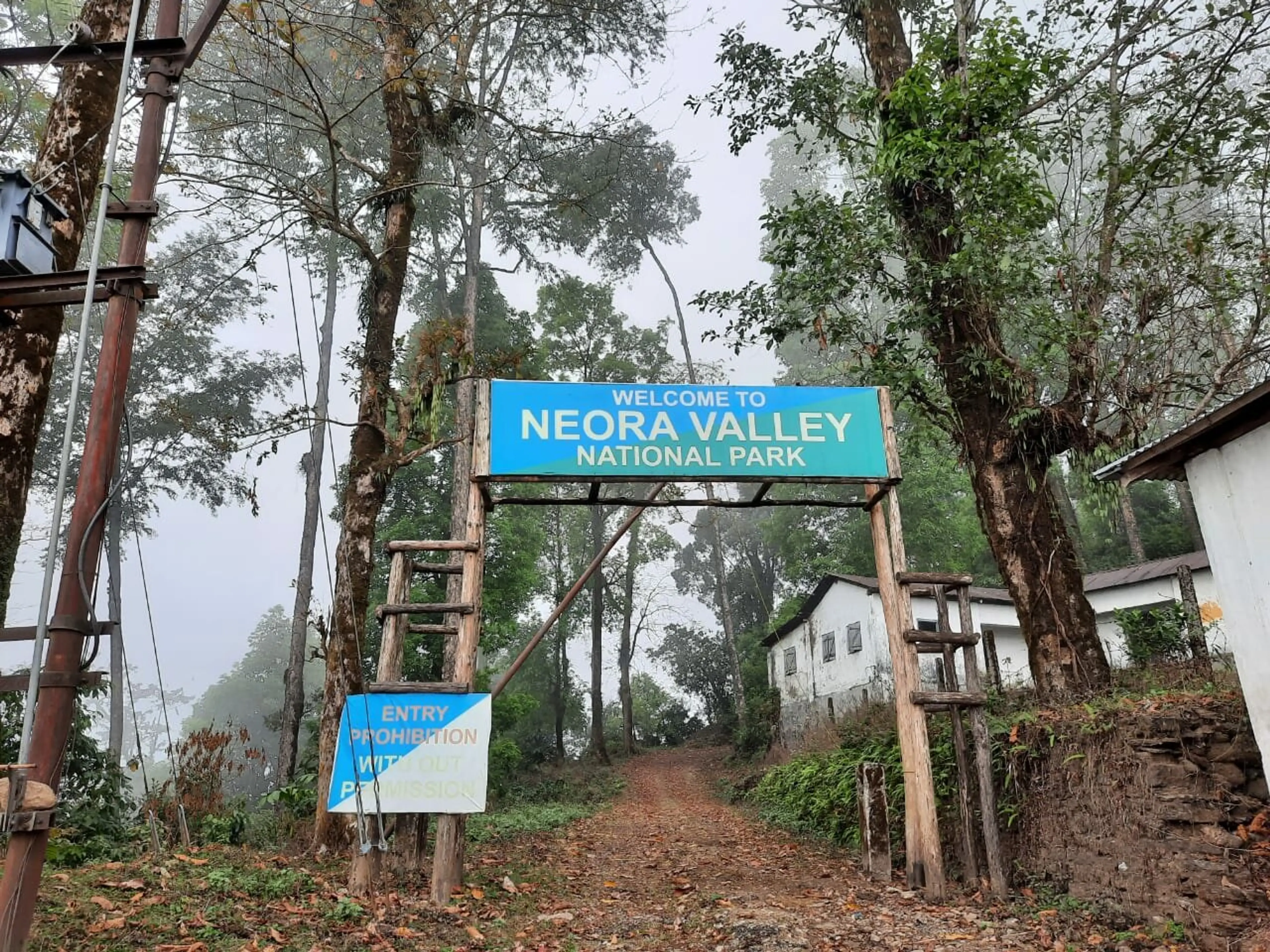
Access to Neora Valley is deliberately limited. Entry requires permission, reinforcing the understanding that this forest is not open terrain but a sensitive environment with boundaries. Familiarity with the Neora Valley travel permit process is part of preparing for the experience, signalling that care begins before arrival. Regulations are not framed as obstacles, but as safeguards for an ecosystem that depends on stability.
Once inside, low-impact practices become essential. Group sizes remain small, movement is confined to existing trails, and overnight stays are carefully managed. Noise, litter, and artificial light are minimised, allowing nocturnal rhythms to continue uninterrupted. These measures reflect broader principles of ethical travel practices and non-extractive travel ethics, where presence is conditional and responsibility shared.
Neora Valley also reflects community-led conservation models, where protection is sustained through cooperation between forest authorities and local communities. This balance prioritises long-term ecological health over visibility. Travellers who approach the forest with humility contribute to this continuity, recognising that restraint, rather than access, is what allows the cloud forest to endure as a living system.
Why Neora Valley Appeals to the Thoughtful Traveller
Who This Forest Experience Is (and Is Not) For
Neora Valley does not cater to travellers seeking rapid movement, guaranteed sightings, or dramatic landscapes framed for photography. It offers no clear narrative arc and no promise of constant engagement. Instead, it appeals to those willing to enter uncertainty and remain attentive without expectation. Travellers familiar with protected Himalayan valleys and nature-based journeys in North Bengal often recognise this immediately, understanding that the forest operates on its own terms.
This experience resonates with those interested in anthropological perspectives on place, place-based ecological systems, and slow travel philosophies. It suits travellers who value immersion over outcome and who are comfortable with moments of ambiguity. Neora Valley does not reward urgency; it responds to patience, stillness, and attentiveness.
For such travellers, spending time in the Neora Valley ecosystem becomes an exercise in listening rather than searching. It aligns with values shared across Eastern Himalayan forest landscapes and low-impact wildlife regions, where resilience depends on limitation rather than exposure. In remaining understated, Neora Valley preserves its integrity, offering a rare opportunity to experience a cloud forest as a living, breathing environment rather than a destination to be completed.