
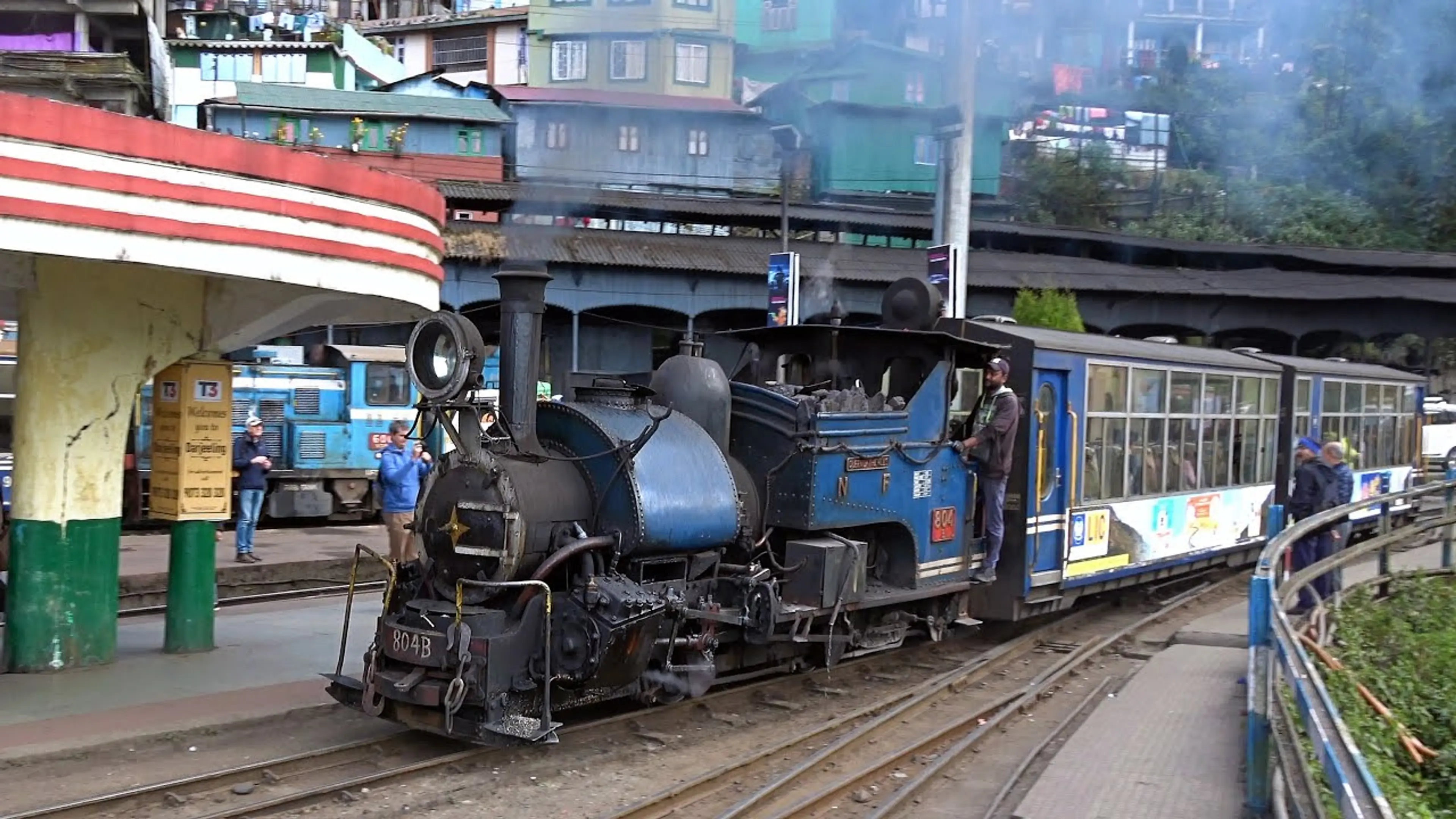
Darjeeling Toy Train — The Little Engine That Conquered the Hills
What makes the Darjeeling Toy Train timeless
The Darjeeling toy train is not simply a heritage attraction; it is the emotional and historical spine of hill travel in North Bengal. For more than a century, the Darjeeling toy train has climbed patiently from the plains toward the mist-covered ridges of Darjeeling, shaping how travellers arrive, observe, and remember the hills. Unlike modern rail journeys designed for speed and efficiency, the Darjeeling toy train invites slowness. It transforms movement into experience, where every curve of the track reveals tea gardens, roadside life, and mountain air moving across open windows.
What sets the Darjeeling toy train apart is its intimacy with the landscape. The railway does not cut through the mountains; it winds around them, often running parallel to roads, village homes, and marketplaces. This closeness allows passengers to see daily Himalayan life unfold at arm’s length. Travellers researching the region through a Darjeeling destination guide often discover that the Darjeeling toy train is not an optional excursion but a defining layer of the destination itself. The train becomes the thread that connects scenery, people, and memory.
The Darjeeling toy train has also remained culturally relevant in the digital age. Across platforms such as Google Travel, the journey is described less as transport and more as a moment of arrival — the point at which the hills begin to feel real. This emotional resonance explains why the Darjeeling toy train continues to draw travellers long after faster roads and alternative routes have emerged.
Why the Darjeeling Toy Train is more than a scenic ride
A railway shaped by the mountains
The Darjeeling toy train was born from necessity. Connecting Darjeeling to the plains required an approach that respected fragile hill terrain, steep gradients, and unpredictable weather. The solution was a narrow-gauge railway that worked with the contours of the land rather than against them. Through loops, reverses, and tight curves, the Darjeeling toy train climbs gradually, making its engineering logic visible to every passenger. This transparency of design turns the journey into a lesson in adaptation and ingenuity.
Because the Darjeeling toy train moves slowly, travellers have time to notice how the railway fits into the environment. Tea bushes line the track, prayer flags flutter above small stations, and mountain roads briefly pause to let the train pass. Travel writers and photographers frequently highlight the Darjeeling toy train on Tripadvisor for this reason: it does not isolate travellers from the region; it immerses them within it. For those browsing Himalayan travel ideas, the Darjeeling toy train often emerges as a symbol of travel that values depth over distance.
Living heritage, not a museum piece
Unlike static heritage monuments, the Darjeeling toy train remains alive. It carries visitors, locals, railway staff, and stories through the same corridors it has followed for generations. Children wave as the train passes their homes; shopkeepers pause as the whistle echoes through narrow streets. This everyday interaction is what transforms the Darjeeling toy train into living heritage rather than preserved nostalgia.
International recognition through UNESCO World Heritage status has amplified awareness of the Darjeeling toy train, but its true value lies in continuity. The railway is not frozen in time; it evolves carefully while maintaining its character. Even modern ticketing systems such as IRCTC now serve a railway whose soul remains tactile and human. This balance between global recognition and local rhythm makes the Darjeeling toy train a powerful example of heritage that still breathes.
How the Darjeeling Toy Train fits into a modern travel journey
Experiencing the hills at a human pace
In an era defined by accelerated tourism, the Darjeeling toy train offers a rare alternative. It's measured pace encourages observation rather than consumption. Passengers notice changes in altitude, temperature, and vegetation; they feel the hills rather than simply seeing them. This is why the Darjeeling toy train integrates naturally into immersive itineraries curated under Darjeeling tour packages, where the journey itself becomes as meaningful as the destination.
The Darjeeling toy train also pairs seamlessly with thematic travel experiences. Combining the ride with Tea plantation tours in the Himalayas reveals how the railway once enabled the tea economy to thrive, linking estates to markets and ports. Similarly, journeys that include Village experiences in the Eastern Himalayas allow travellers to see how communities grew alongside the tracks, adapting daily life to the rhythm of passing trains.
A journey that defines the destination
For many travellers, Darjeeling is unimaginable without the Darjeeling toy train. Its whistle is part of the town’s soundscape; its silhouette curves through postcards and photographs. National tourism narratives promoted by Incredible India often highlight the Darjeeling toy train not just as an attraction, but as a symbol of India’s layered travel heritage. The railway represents a way of moving through landscapes that values patience, craftsmanship, and connection.
Ultimately, the Darjeeling toy train endures because it offers something increasingly rare: authentic slowness rooted in place. It allows travellers to arrive gradually, to absorb the hills as they rise around them, and to understand Darjeeling not as a checklist destination but as a journey that unfolds curve by curve. The Darjeeling toy train does not merely take travellers to the mountains — it teaches them how to see them.
Origins of the Darjeeling Toy Train and the Making of a Mountain Railway
Why the Darjeeling Toy Train was conceived
The story of the Darjeeling toy train begins not with romance, but with urgency. By the late nineteenth century, Darjeeling had emerged as a strategic hill station, administrative centre, and tea-producing region. Reaching the hills from the plains, however, was slow, expensive, and physically exhausting. The British administration needed a reliable transport system that could move officials, supplies, and tea while respecting the fragile Himalayan terrain. The Darjeeling toy train was conceived as that solution—a railway that would climb where conventional railways could not.
What makes the Darjeeling toy train historically significant is that it was never meant to overpower the mountains. Instead, engineers designed a narrow-gauge system that could bend, loop, and reverse its way uphill. This philosophy of adaptation defined the railway from the outset. As the Darjeeling toy train advanced, it stitched together hill settlements, tea estates, and forest clearings, slowly transforming Darjeeling from a remote outpost into a connected mountain town. Travellers today exploring the Darjeeling destination experiences often retrace this same ascent, unknowingly following a route that once reshaped the region’s economy and identity.
Engineering choices that defined the Darjeeling Toy Train
The engineering of the Darjeeling toy train was revolutionary for its time. Rather than tunnelling aggressively or relying on rack-and-pinion systems, designers employed loops, spirals, and zigzags to manage elevation. These features allowed the Darjeeling toy train to gain height gradually while maintaining safety and stability. The result was a railway that revealed its intelligence openly—passengers could see the track looping below them or reversing direction to conquer steep gradients.
This visibility is one reason the Darjeeling toy train continues to fascinate railway historians and travellers alike. On platforms such as Google Arts & Culture, the line is often discussed as an example of engineering that prioritised sustainability long before the term became fashionable. The Darjeeling toy train demonstrated that infrastructure could coexist with landscape rather than dominate it, a lesson that resonates strongly in modern Himalayan travel planning and curated slow travel journeys in the Himalayas.
The Darjeeling Toy Train and colonial-era transformation
As the Darjeeling toy train expanded, it fundamentally altered life in the hills. Tea estates flourished because the railway enabled faster transport of tea leaves to markets. Hill towns grew along the tracks, and stations became social hubs where news, goods, and people converged. The Darjeeling toy train did not merely serve Darjeeling—it shaped it. Entire neighbourhoods aligned themselves to the rhythm of passing trains, and daily schedules adjusted around arrival and departure times.
This transformation explains why the Darjeeling toy train appears repeatedly in colonial-era travel writing and photography, now archived across platforms such as British Library collections. Yet the railway was never only a colonial instrument. Local communities adopted it quickly, using the Darjeeling toy train as a lifeline rather than a symbol. This dual identity—imperial in origin, local in use—adds complexity to the railway’s history and makes it an essential subject for travellers interested in layered narratives rather than simplified heritage.
Survival, decline, and renewal
The twentieth century brought challenges. Roads improved, vehicles multiplied, and landslides periodically damaged the line. At various points, the Darjeeling toy train faced questions about its relevance and cost. What saved it was not efficiency, but meaning. Travellers, conservationists, and railway enthusiasts increasingly recognised that the Darjeeling toy train represented something irreplaceable: a living record of how humans once negotiated difficult landscapes with patience and care.
This growing appreciation led to renewed attention and protection, eventually culminating in global recognition through UNESCO World Heritage listing. That status reframed the Darjeeling toy train as part of a broader story of mountain railways and human ingenuity. Today, modern platforms such as National Geographic Travel often reference the Darjeeling toy train as an example of heritage travel that remains authentic rather than theatrical. For travellers browsing heritage-focused travel packages, the railway stands out as a journey that educates as much as it delights.
The Darjeeling Toy Train as a historical experience today
Riding the Darjeeling toy train today is to move through history at the pace it was built for. The whistle echoes through the same valleys, the curves follow the same logic, and the stations still occupy the same social spaces. This continuity is why the Darjeeling toy train integrates so naturally into immersive itineraries offered through cultural travel experiences in the Eastern Himalayas. The journey is not reenacted—it is ongoing.
Even in a digital age dominated by instant booking and rapid movement, the Darjeeling toy train resists simplification. It cannot be rushed or reduced to a single photograph. Travel platforms like Lonely Planet often emphasise that understanding Darjeeling requires experiencing the railway, not just reading about it. The Darjeeling toy train remains a reminder that some histories are best understood through movement, sound, and time spent looking out of a window as the mountains slowly rise to meet you.
The origins of the Darjeeling toy train, therefore, are not confined to a date or an engineering plan. They live on in the way the train still moves through the hills—patient, observant, and deeply rooted in place.
Darjeeling Toy Train as a World Heritage Railway and Contemporary Travel Experience
How the Darjeeling Toy Train earned global recognition
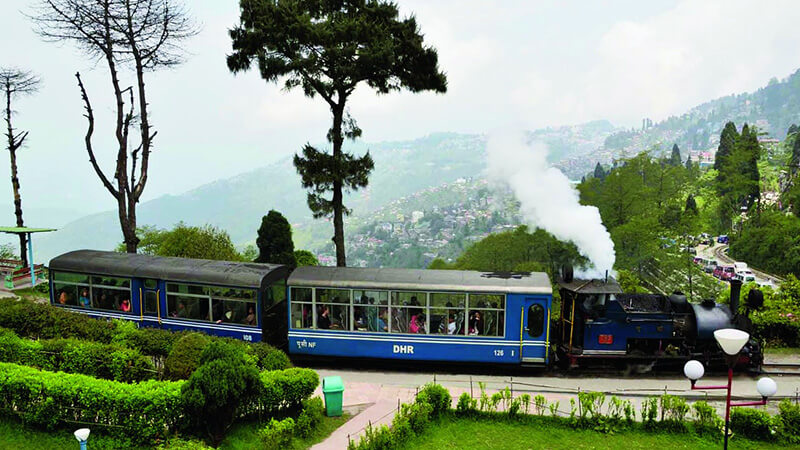
The Darjeeling toy train occupies a rare position in global travel history: it is both a working railway and a recognised cultural treasure. Over time, the Darjeeling toy train came to be understood not merely as colonial infrastructure, but as an outstanding example of how engineering adapted intelligently to mountainous terrain. Its gradual ascent, reliance on loops and reverses, and close integration with settlements distinguished it from other hill railways. These qualities eventually led to international recognition, placing the Darjeeling toy train among the world’s most significant heritage rail systems.
What sets the Darjeeling toy train apart in heritage terms is authenticity. The railway was not reconstructed to simulate the past; it continues to operate along its original alignment, preserving the rhythm and scale of nineteenth-century mountain travel. This authenticity is why global cultural platforms such as UNESCO World Heritage frameworks identify the Darjeeling toy train as part of a living landscape rather than an isolated monument. For travellers seeking depth, the Darjeeling toy train offers heritage that can be experienced physically, not just observed.
Conservation without losing character
Preserving the Darjeeling toy train has never meant freezing it in time. Instead, conservation efforts have focused on maintaining operational continuity while respecting historical integrity. Tracks are stabilised, stations maintained, and locomotives restored with care to ensure that the Darjeeling toy train remains both safe and true to its origins. This balancing act is delicate: modern safety expectations must coexist with heritage values, and efficiency must never overpower experience.
For travellers planning journeys through heritage travel in Darjeeling, this balance is visible everywhere. The Darjeeling toy train still passes through busy streets and quiet villages, still whistles at crossings, and still pauses at small stations where the mountains feel close enough to touch. International travel media such as National Geographic Travel frequently highlight this equilibrium, describing the Darjeeling toy train as an example of conservation that protects meaning rather than merely preserving appearance.
Riding the Darjeeling Toy Train today
Experiencing the Darjeeling toy train today is as much about mindset as logistics. The journey demands patience and rewards attentiveness. Passengers who approach the Darjeeling toy train as a slow unfolding rather than a checklist attraction often find that it becomes the emotional core of their trip. This is why the railway features prominently in curated Darjeeling tour packages that emphasise immersion over speed.
The Darjeeling toy train offers multiple ways to ride, from short joy rides to longer ascents from the plains. Regardless of distance, the defining quality remains the same: closeness. Homes, shops, tea bushes, and prayer flags pass at eye level, creating a sense of participation rather than observation. Travel communities on platforms like Tripadvisor consistently describe the Darjeeling toy train as a journey where interaction—waving to locals, exchanging smiles at stations—matters as much as scenery.
Integrating the Darjeeling Toy Train into a Himalayan itinerary
The Darjeeling toy train fits naturally into broader Himalayan journeys because it explains the landscape as it moves through it. Travellers combining the ride with Tea plantation experiences in Darjeeling begin to understand how transport enabled tea culture to shape the hills. Those pairing it with Village life experiences in the Eastern Himalayas see how communities evolved alongside the tracks, adapting architecture, livelihoods, and daily routines to the railway’s presence.
Modern travellers increasingly look for journeys that connect stories rather than isolated attractions. The Darjeeling toy train provides that connective tissue. Digital planning tools such as Google Travel often surface the railway as a defining experience because it anchors Darjeeling within a larger narrative of Himalayan exploration. The train becomes the thread that ties together landscapes, history, and contemporary travel.

Why the Darjeeling Toy Train still matters to travellers
In a world of accelerating movement, the Darjeeling toy train represents resistance to haste. It reminds travellers that arrival can be gradual, that understanding a place requires time, and that travel can be participatory rather than consumptive. National tourism narratives promoted through Incredible India frequently use the Darjeeling toy train to symbolise this philosophy: a journey that values craft, patience, and continuity.
For travellers exploring responsible Himalayan travel experiences, the Darjeeling toy train offers more than nostalgia. It demonstrates how heritage infrastructure can remain relevant without becoming theatrical. The railway continues to serve, to move, and to teach. Ultimately, the Darjeeling toy train endures because it offers something that modern travel often lacks—a sense that the journey itself is the destination, and that the mountains are best understood one slow curve at a time.
How Tourists Can Enjoy the Darjeeling Toy Train Today
Practical travel planning and experience tips
Understanding the Darjeeling toy train timetable and how it operates is essential for planning a smooth, memorable journey through the Himalayas. Unlike high-speed trains that focus on efficiency, the Darjeeling toy train celebrates pace and proximity to the landscape, turning every stop and whistle into part of the experience. Whether you’re aiming for a full-length scenic ride from the plains or a joy ride between Darjeeling and Ghum, knowing key schedule patterns helps you align travel days, photography windows, and connection points with local explorations.
Many visitors start by deciding what kind of toy train experience they want — a short scenic hop that lets them enjoy ridgeline views and tea gardens at leisure, or a longer route that connects major hill stations. Each choice comes with its own rhythm and timing, and being aware of the Darjeeling toy train’s daily operations allows travellers to plan hotel check-ins, sunrise views, and tea estate visits around rail segments rather than against them.
Below is a timings table based on official service patterns published by the Indian Railways DHR services portal and current timetable summaries. Timings for heritage and joy rides often vary by season and day of the week, so always confirm via the official DHR rail portal or ticket counters before you travel.
Darjeeling Toy Train — Typical Service Timings
|
Service Type |
Train/Route |
Departure |
Arrival |
Approx Duration |
|
Full Hill Route |
NJP → Darjeeling (52541) |
10:00 |
17:20 |
~7 hr 20 min |
|
Return Full Route |
Darjeeling → NJP (52540) |
09:00 |
16:30 |
~7 hr 30 min |
|
Kurseong → Darjeeling |
Toy Train Passenger (52587) |
06:30 |
09:05 |
~2 hr 35 min |
|
Return Kurseong |
Darjeeling → Kurseong (52588) |
16:00 |
18:40 |
~2 hr 40 min |
|
Short Joy Ride |
Diesel Joyride (52591)** |
09:45 |
11:25 |
~1 hr 40 min |
|
Short Joy Ride |
Steam Joyride (52592)** |
14:00 |
15:55 |
~1 hr 55 min |
(Note: Steam and heritage joy rides may run on select days or during peak seasons only; always check with the official DHR Indian Railways portal before booking)
These trains demonstrate different ways tourists can enjoy the Darjeeling toy train:
- Full scenic route (NJP–Darjeeling): Best for travellers arriving from the plains who want to experience the long-haul mountain climb. It’s a full-day journey, offering changing panoramas from tea estates to forested ridges and hillside towns.
- Kurseong hill segment: Ideal for day trips, this route captures the heart of the Darjeeling toy train’s engineering marvels and offers plenty of photographic opportunities around hairpin bends and station halts.
- Joy rides and heritage runs: Perfect for shorter time frames, these give travellers a flavour of the iconic experience without the commitment of a full-day schedule, and are especially popular with photography groups and heritage enthusiasts.

Choosing the right season and ticketing strategy
When planning Darjeeling toy train travel, seasonal weather patterns play a crucial role. While the hills are enchanting, the monsoon months (roughly mid-June to mid-September) can sometimes cause intermittent cancellations as tracks are checked or repaired after rainfall. Travellers who align their plans with the drier months often enjoy clearer views and more predictable train operations, allowing them to make the most of time on board and off.
Ticketing for the Darjeeling toy train is typically done through the official Indian Railways booking system — either online via IRCTC or at station counters. Advanced booking is advisable, especially during peak tourism seasons and for steam-hauled heritage runs, which have limited seats and high demand. Many travellers choose first-class or vistadome seating where available to maximise views and comfort on longer journeys.
Enhancing your travel experience around the Toy Train
The timing and choice of Darjeeling toy train segments often shape the rest of a traveller’s itinerary. For example, a morning departure on a hill-segment train allows enough daylight for tea estate tours or village walks in the afternoon, while an evening return from Kurseong can lead naturally into sunset vistas from local viewpoints. Travellers often use platforms such as Darjeeling tour packages to combine their ride with other signature experiences — from tea tastings to cultural walks — creating a cohesive and locally grounded journey.
Photographers and slow-travel enthusiasts particularly value the Darjeeling toy train because its timetable encourages lingering: waiting for the train at quieter halts, taking pictures of mist rolling over ridges, or interacting with station staff and locals during stops. These interactions turn a train timetable into a lived rhythm rather than a rigid schedule, inviting travellers to become part of the landscape’s tempo.
Safety and accessibility on the Toy Train
Although the Darjeeling toy train is a heritage service, safety standards are maintained through regular inspections and staff training. Stations are accessible for most travellers, and conductors are accustomed to assisting passengers unfamiliar with hill rail travel. Because the train often shares space with road traffic at small crossings and markets, travellers are advised to follow crew guidance and remain mindful of local movement around the tracks.
Whether you’re a first-time visitor or returning to the hills, understanding how the Darjeeling toy train operates — through its timetable, seasonal rhythms, and ticketing nuances — allows you to frame your journey with intention and joy. In doing so, the ride becomes not just a passage between places, but a meaningful travel experience that stays with you long after the journey ends.
Why the Darjeeling Toy Train Still Matters
In the end, the Darjeeling Toy Train endures because it offers something that modern travel increasingly forgets how to provide: a sense of arrival earned slowly. It is a journey that teaches patience, rewards attentiveness, and reveals the Himalayas not as a dramatic backdrop but as a lived, working landscape shaped by people, history, and careful engineering. Long after the whistle fades and the tracks curve out of sight, what remains is not just the memory of a train ride, but an understanding of Darjeeling itself—its rhythms, its resilience, and its deep connection to the mountains that rise around it.